Your Delray Boca

Your Guide To The Delray Beach Boca Raton Lifestyle

  • Home
  • About
  • Business Directory
  • News
  • Events
  • Opinion
  • Restaurants
  • Shopping
  • Real Estate
  • Insider’s Guide
27 February, 2023 6 6 Comments
Tweet

The Long And Winding Road Cities Take

February 27, 2023 By Jeff Perlman 6 Comments

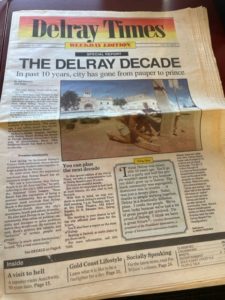
I found this old newspaper from January 1995 chronicling Delray’s Decade of Excellence.

Thirty-six years ago, I fell hard for Delray Beach.

Like so many others, I moved here to start a new life; attracted by the sunshine and the promise of a new hometown.

I was fortunate to find both.

In 1987, Delray Beach was a very different place than it is today.

The city was known as “Dullray Beach” in those days because the downtown was dead and everything new and exciting seemed to be happening in Boca or elsewhere.

But Delray was anything but dull in the 80s.

The politics were—to be kind—“lively”, crime was through the roof and there was no shortage of things for a young reporter like me to write about.

So, write I did. At least five stories a week for a decade.

From the back of a police cruiser, I rode with our officers through neighborhoods that were open-air drug markets and marveled at the scope of despair. Late at night, I saw small children on bikes working as look outs for drug dealers. When they spotted police, the kids would signal the corner drug dealer who would scatter into the night. People lived in fear—they had lost their streets to the crack dealers.

On Atlantic Avenue, I went into a bar one warm summer evening and saw a woman take off her shoe and stab someone with her stiletto because the victim glanced at her boyfriend.  At City Hall I watched elected officials do the same thing (metaphorically speaking) to each other.

But despite the crime, the grime, and the slime, it was an interesting time.

My new town was aspirational.

You could feel the momentum building toward positive change. It was an electric time, a transformational era. I had a bird’s eye view and I loved every moment of the ride.

In those days, there was a strong desire to make the downtown vibrant.

There was a passion to preserve historic districts.

There was also a thirst to bring stability to local government because the leaders at the time understood that a well-run city was essential to success and that government could partner with others to bring dreams to life. Bad government stifles investment and innovation, good government facilitates. Our leaders understood that and made it happen.

Our citizens at that time were active and engaged—there were multiple opportunities to connect, to volunteer, to have your voice heard. Things were happening.

The rusted chain link fence that surrounded the property on Atlantic and Swinton came down and a new cultural arts center came to be thanks to a visionary named Frances Bourque.

Frances came up with the idea and worked closely with citizens and city government to bring the dream to life.

In 1991, a new City Manager came to town and hired a new police chief and almost overnight we had stability at City Hall and a new focus on making our city safe.

Two years before in 1989, voters went to the polls and approved the Decade of Excellence bond which financed $21.5 million worth of projects that citizens asked for as part of a visioning process called Visions 2000.

A year after the bond passed, a new era in politics dawned with the election in 1990 of a new mayor and two commissioners who ran on a promise to promote stability and civility.  They delivered and our town changed.

From that point forward— and for a good long time– a lot of important things happened. Delray went from “Dullray” to All America City, Best Run Town in Florida and Most Fun City in America. There was a lot of civic pride, a lot of collaboration. Ties were formed and some barriers that had been built up over the years began to crumble.

Of course, not all was perfect or smooth. It never is.

There were challenges, speed bumps and events that nobody could ever foresee.

Yesterday, was the 18th anniversary of the loss of Jerrod Miller, a 15- year- old teenager shot to death by a rookie police officer outside a school dance.

You think you understand pain, you think you are prepared for anything until violent tragedy visits your city.

You quickly learn that you are not prepared. You learn the importance of building a reservoir of goodwill before tragedy strikes, because trying to build it after is too late. You have nothing to drawn on if you start engaging after the fact.

You also discover that there is no “how to” manual to guide you when you learn that several of the 9/11 terrorists were biding their time in your town, preparing for an attack that would change our world.

There were hurricanes, development controversies, a few scandals and the normal squabbles over bike lanes, parking and the merits or demerits of traffic circles. But for the most part it was a happy and immensely proud village.

Civic pride is a real asset because when people fall in love with their city they give back, they act with kindness and care. They become stewards and evangelists and a virtuous cycle takes root that enables progress; great, lasting, and meaningful progress.

But the last several years feel different; to me and many others I speak with.

We’ve gone off track.

We’ve stopped working together, we’ve stopped consulting the public and consequently we gave back a lot of what we worked so hard to achieve.

Yes, I know the sun is still shining.

The Avenue is still rocking.

The beach is still beautiful.

But our neighborhoods have changed—big money has come to town and knocked down some old houses.  Many longtime residents are cashing out, especially in our eastern neighborhoods. We ought to stop long enough to understand what that means. Will these newcomers vote? Will they volunteer? Will they send their kids to school? Will they care about this place? Do we value the character of neighborhoods?

Young families and essential workers are having a hard time finding a place to live in our community. We need to understand how that impacts our city, schools, and business community. Every apartment complex voted down is an opportunity lost for a nurse, teacher, police officer or firefighter to get a toehold in our community so that maybe they can make a life here.

And I remembered….

There was a lot of protesting against Mallory Square when it came time to vote on that project years ago. The stylish and beautifully landscaped townhomes on U.S. 1 were going to replace a Chevy dealer and some residents thought it would add too much traffic to Federal Highway.

Planners will tell you that residential uses generate less trips than commercial uses but some people didn’t believe that. Still, people don’t move to a downtown to drive, and the dealership had a lot of employees who came and went, a lot of customers and a slew of test drives.

The project was approved.

I think it worked out.

I thought about that mini controversy the other day when I went to dinner with a Mallory Square resident who is quietly changing lives in our town. He works with kids who need a hand up, not a handout.

Might he have moved elsewhere had that project been denied? Might another community have benefitted from his generous heart if that opportunity to put down roots here didn’t exist?

What other game changers might move into our town if we create more opportunities for our workforce to live here?

Other things have changed as well.

Public engagement—long Delray’s secret sauce has left the building.

And as much I despise Covid, it can’t all be blamed on the virus.

The annual town hall meeting is AWOL.

City Commission meetings begin at 4 p.m.– during the workday for a large swath of the population which means they cannot participate.

Government has taken over our highest profile non-profit: Old School Square.  And it looks like volunteerism went the way of the Blackberry—fondly remembered by a few diehards but no longer ubiquitous; no longer a way of life. At one point we had over 1,200 volunteers at our Police Department, we had hundreds of people who participated in crafting the downtown master plan, volunteers resurrected Pineapple Grove, read to kids in local schools and showed up at countless charettes to share their vision of their city.

Has it all moved online?
Is that a good thing?

Facebook is a fine invention, great for scoping out old flames (or so I’m told), favorite former teachers (that’s you Mr. Romanelli) and college buddies. It’s also terrific for looking at pictures of babies and furry friends, but it’s a poor substitute for community.

The best things about the All America City Competition was the community building aspect of the effort. Same with festivals, Friday night concerts, community pot-luck dinners and study circles, which looked at issues relating to race relations.

This entire city was focused on trying to get citizens involved and engaged.

In a few weeks, you will be asked to vote on two General Obligation bonds totaling $120 million. I can’t find anyone who knows much about it.

Where are the specifics? Why now, when interest rates are climbing, and inflation is raging? Did the public have input into these projects?

Where was the promised public education campaign? A Town Hall meeting a few weeks before the election seems inadequate for what will be the largest bond issue—by far—in the city’s history.

And I can go on and on.

But let’s just say these are symptoms of a larger disease.

Here’s what I’m seeing; just one guy’s opinion based on 36 years of immersion in all things Delray.

The public is being removed from the public’s business in a town that re-invented itself and met its challenges through civic engagement. If you don’t consult the community, you can’t serve the community.

Dedicated volunteers are being sidelined and replaced by more government; sometimes that means your money is being used to settle political feuds: the prime example is Old School Square, which was an 80-20 partnership, with 80 percent of the money it costs to run the facility raised privately. That was a good deal and it worked. Until now.

Why? That’s the question posed by signs I see around town. And it’s a good question.

Lies and harassment are taking the place of dialogue in a town that once prided itself on trying to have honest conversations, even if, especially if the subject matter, wasn’t pretty.

Vote accordingly.

We can do better than this.

We must, because so much is at stake.



21 September, 2020 24 24 Comments
Tweet

The Recipe Is People Based

September 21, 2020 By Jeff Perlman 24 Comments

Last week, I wrote a blog about how far Delray Beach has strayed since the days when Florida Trend referred to the city as the best run town in Florida.

I received a tremendous response indicating that the piece struck a nerve.
That was the intent; with an admonition for citizens to get involved. We can and must do better.
But while the piece was mostly “diagnostic” outlining where we’ve gone off track, one gentleman wrote to me and asked for solutions.
I don’t claim to have all or even some of the answers. Nobody does. The whole point is for citizens to get involved because I believe that the more stakeholders are at the table the better we are as a community.
But aside from involvement and voting (too few of us do) here are a few thoughts on how we can fix what’s ailing us.
Unfortunately many of these ideas are hard to accomplish during a pandemic but we can surely lay the groundwork now for a civic comeback later.
I’m limiting my list to community unity concepts because we have to repair the civic fabric before we can heal and move forward.

There are a slew of other things we will need to do to rebuild the economy but for now let’s concentrate on unifying the community.
Here are a few ideas:
Get back to citizen driven planning and visioning. —Delray was built on grass roots involvement in crafting a vision for the future. We haven’t had a large scale all hands on deck planning and visioning exercise in many years. It’s time to invite citizens to the table to talk about our future. Nature abhors a vacuum and in the absence of a vision we have invited petty politics to take over. It’s time for a new vision that includes everyone. You know you’ve gone wrong when commissioners focus on each other and not the vision. In the absence of a vision it’s inevitable.

Restore civic education—Delray was once known for its efforts to engage the community through efforts such as the Residents Academy, Youth Council, Elder Ready Task Force and Police Academy. These efforts enabled citizens to learn about their city and to volunteer for boards etc. It was invaluable. A great way to connect people to their hometown.

Bring back community dinners—The Commission I served on created Community Dinners where we invited diverse neighborhoods to gather at Old School Square for a potluck dinner and fellowship. Commissioners and senior city staff attended and facilitated conversations covering topics of concern to the neighborhoods. The low cost, high impact events built relationships and bridged divides. Those evenings were magical.
Emphasize commission goal setting—When your commission is split it’s important to find common ground, areas where everyone can agree. Once those goals are set, it enables city staff to get to work and get things done. If goals are achieved, commissioners succeed. So even if you have a commission that doesn’t get along you are guaranteed to get some things done.
Dust off plans that have been shelved— Adopt and implement the Set Transformation Plan, Congress Avenue Plan and US 1 overlay. We spent taxpayer money and citizen time to create these plans. They are good plans and we need to get moving again. When citizens volunteer only to see their work ignored, cities pay a high price. People stop caring.  Consequently, when they see plans implemented they take pride in their work and their towns.

Recommit to key civic projects— It seems like every year, Old School Square and other important civic projects have to fight for their survival. We need to commit to these endeavors which sends a message to volunteers and donors that the city is firmly behind these projects. That doesn’t mean that Old School Square and the Arts Garage etc., are above accountability. They need to perform. But it does mean they can rely on the city as a trusted partner. City Hall needs to be viewed as an ally not a critic. And if  criticism is  warranted, then it should be constructive.
Celebrate success—In days gone by, when goals were reached we threw a party. Yes sometimes it was goofy but it also builds morale and civic pride. We will all need a party when the pandemic eases.
Restore trust—Sure that’s easier said than done. But it takes time, patience and performance. There was a time when local governments nationwide were the most trusted form of government. People trust leaders when they are accessible, transparent and when they deliver on promises and own up to mistakes.
Show support for city workers—Public and private praise goes a long way. We have many dedicated public servants.  It’s important to appreciate their contributions.

—Honor the past, encourage the future. -This City has been blessed with a slew of amazing people. We should reach out to remember and honor them. We should also scan the landscape for new and emerging civic talent and take the time to encourage them. It doesn’t cost money. But the return is invaluable.
Call out the civic bullies—Recently, the city commission did a great thing by calling out someone who stepped out of bounds on social media. It was a bold and needed correction. We need to insist on civility and have the courage to stand up to those who cross the line. It’s ok to passionately argue for issues that we care about. It is not ok to get personal or go after family members or the livelihoods of elected officials.
Identify a Big, Audacious Goal and Get it Done—Civic projects that involve the community can be bonding experiences. In the past we have created goals for culture, the downtown, education and neighborhoods. All of these efforts brought people together. We can sure use another effort we can sink our teeth into. Suggestions? How about the Old School Square Park? The parks bond was passed 15 years ago. It’s time to create a sensational public space and create a process that invites the community to get involved.

These are just a few ideas.
But the number one solution is to stay informed and get involved. Delray needs you.
12 April, 2018 2 2 Comments
Tweet

The Measure of Success

April 12, 2018 By Jeff Perlman 2 Comments

“Great leaders in any arena are great not just because they hit more runs out of the park, but because they give us something to believe in and belong to. They show us the best of us, reflecting that what we do when no one is watching, is who we are.” Bernadette Jiwa


Leaders have to be learners.

If you aren’t learning, you aren’t leading.

Why?

Because nobody has all the answers and if you think you’re the smartest guy or gal in the room you’re either mistaken —or in the wrong room.


In order to learn, you have to be open-minded—open to learning and growing as a person and as a leader.


Last week, we swore in a new mayor and three new commissioners in Delray Beach.


All over town, there’s excitement and a sense that perhaps we can turn over a new leaf and begin again.


It’s no secret that I’ve been highly critical of the past mayor. I didn’t want to be.  After all, we were friends and I backed him when he first ran. But I was disappointed in his approach to the job. In my opinion, he chose a ‘go it alone’ model of governing. If you want to be an effective leader, going it alone is not an option.

You can’t go it alone.

It is not a sustainable model for a city.

But there’s lessons to be drawn from every experience and we’d be foolish not to learn from them.

I’ve been watching municipal politics here and elsewhere for over 30 years—first as a journalist, then as a direct participant and now as a member of the PIPS–previously important people.

Here’s what I’ve seen work and what I have seen fail. This is not a comprehensive or complete list, just highlights and observations.

What Works

–Those who learn and grow in office succeed. Take the time to read, study other cities, learn about local history, speak to a cross section of the community and build relationships. For example, if you want to understand urban planning there are blogs like Planetizen and trade pubs like Planning. You can read Jane Jacobs, visit the Strong Towns website, City Lab and Smart Cities Dive to get an overview of thinking on a vast array of topics. You can also chat with local planners–they tend to be pretty cool people. The same goes for all the other topics from public safety and municipal finance to economic development and civic engagement–there is a treasure trove of helpful information if you are open to learning, listening and engaging with people.


-It’s a job to do, not a job to have. You are only there for a short period of time. Make it count. Don’t be afraid to speak your mind. Be transformational not transactional. The former ensures a legacy, the latter is forgettable.


–Work with staff, not on them. Don’t micromanage, but don’t be afraid of accountability either. Mistakes are going to be made—we’re humans. The key is not to repeat mistakes and to learn from those you and others make. Good leaders give people space to shine and own their own mistakes.


–Your job is to lead and provide direction. Staff implements. Get out of staff’s way. You are not the City Manager. You are not the City Attorney either. Or the Planning Director, Finance Director etc. The corollary is also true, don’t tolerate staff being political. If they want to make political statements they should run for office and if you want to hire, fire and manage staff you should get a degree in public administration etc.


–Great cities invest and reinvest in themselves so don’t be afraid to do so. You will bump up against those who don’t want to spend and who believe you can cut your way to success. Spending should be prudent, tied to a vision, strategic and smart. There are those who think government’s role should be limited to picking up the garbage, making sure water comes out of your tap and answering 911 calls—all essential but….. But the special cities create value by investing in projects and activities that lead to quality of life enhancements. The best public investments seed the economy and lead to private investment that often dwarfs the public expenditure. Look to create ROI–and understand that sometimes the returns are intangible. The intangibles are important.


–Some people will love you, others will hate you. Seek to serve them all, but if you have to choose (and sometimes you will have to) seek, earn and keep the respect of the doers in your community over the naysayers. The doers are easy to find. They are volunteering, working for your city, serving and investing in your community. The naysayers are not those who disagree with you on an issue or a hundred issues, they are the ones who can’t move on and try to burn down your house because you don’t see the world through their lens.


–Process is important. But outcomes matter. Process without outcomes (results) create a frustrating mess.


–Engage the community. And engage some more. Repeat.


–Build a reservoir of good will. You will need it when the going gets rough and it always gets rough.


–Get people involved. Search for new and old voices and ask them to get busy. Respect those who serve and volunteer. Reach out to all and get their input. You will be a better servant leader if you do. There is wisdom to be tapped everywhere you look but only if you seek it out.


–You work for us, not the other way around. Be a servant leader not a dictator.


–Your personal preference matters to a degree, but ultimately you’ll fail if you make it about you. Stand for the things that build the community. Make decisions for the long term good of the community not your short term political interests.


–Value and respect people and key organizations. You are there to support their missions and goals. That doesn’t mean you can’t question, challenge and push. Just do so with respect.


You’ll fail if you


-Use the word optics. It indicates you’re political.


-Keep your own counsel. You ain’t that smart. Nobody is.


-But don’t give yourself to a political guru and allow someone to be your gatekeeper or outsourced brain.


-Bully or push staff, citizens or volunteers around. Mean doesn’t age well. You may get short term results through fear and intimidation but ultimately you’ll fail– miserably.


–Forget that the loudest voices at the mic, in your email inbox or on social media don’t necessarily represent the majority.


-Have no vision to guide you. Elected officials get in trouble when there is no community vision or North Star. Instead of focusing on the community’s goals and aspirations they create vacuums quickly filled by handlers, special interests and shiny bright objects. Ala carte governing fails, leads to factions and division and frustrates staff and citizens.


Despite the glossy goodbye speeches claiming victory and declaring  that things were “fixed”, I think we’ve been left tired and in a ditch.


If we want to dig out, get moving again, heal divisions, solve problems and seize opportunities we have to do things differently.


Fortunately, we know how. This town wrote the book.

22 February, 2018 5 5 Comments
Tweet

Delray Politics: Another Honest Conversation

February 22, 2018 By Jeff Perlman 5 Comments

P.S. nobody I know wants buildings over four stories.


There’s an urban myth around these parts that seems to rear its head during election season.

I’d like to punch a hole in it.

It’s a stubborn narrative that starts with a whisper… fades…roars back… fades again and persists through the determined efforts and beliefs of an ever changing cast of characters. This week, a candidate sent out an email alleging the existence of a secret group and so the myth lives on.

In short, it’s the theory that there is some behind the scenes group of players who manipulate elections, control elected officials and pillage Delray for the benefits of a few at the expense of many.

Truth be told, we’ve had our share of political gurus and handlers—people who seek to broker votes, control appointments, script commissioners (literally) and steer contracts etc. I wrote about this phenomenon in my book “Adventures in Local Politics.” (shameless plug).

These situations can do a lot of damage, but they don’t tend to be sustainable because at some point you need to deliver results and to achieve results you are required to be both emotionally intelligent (i.e. able to get along with people without resembling Linda Blair in the Exorcist) and policy driven.

The people who make lasting contributions are transformational leaders. Those susceptible to manipulation tend to be transactional—they deliver favors, dole out punishments and end up largely ineffective over time. They come. They go. Their decisions don’t leave a lasting or beneficial legacy.

But I’m not talking about these types of situations. I’m talking about the myth that there exists some secret group who control things in Delray Beach.

Gurus and handlers want to be known as the powerbrokers—that’s how they derive their power. They need you to know how powerful they are and they want you to bow down before them. You have to go through them to secure votes and favors. But the secret group that allegedly exists operates in the shadows.

When I was an elected official—there were rumors of something called “The Machine”—a group that ensured who got elected and then controlled their votes.

There were also rumors of something called “The Gold Report” (I’m not making this up). I once got an email from someone alleging that this organization controlled the people I was sitting next to as if they were Stepford commissioners. Here’s how it allegedly worked: the Gold Report would issue instructions and commissioners were compelled to follow the voices magically planted in their brains. ( Come to think of it, this explains Jon Levinson).

Again, I am not making this up. I have the emails.

These days, as we ramp up for an especially important election, there are allegations of something called a “Cabal” or a secret group that allegedly met in October at a developer’s office on Swinton Avenue.

The definition of a cabal is a secret political clique or faction. Sometimes those factions are called “cells”, or “juntas” formed to promote private views or interests.

I have been following Delray politics for 31 years—10 as a journalist, 7 as a direct participant and all 31 as an active and engaged citizen.

I can say with assurance that there is no machine, I never heard voices from the Gold Report instructing me how to vote and I would be very surprised if the people I hang out with are part of a “cabal” plotting for their own self-interests to the detriment of Delray Beach.

There are however partisans—people who see Delray differently than others do. This is why we have contested elections.

People support candidates who back their particular viewpoints. It’s really that simple. Local elections are passionate because they are up close and personal. We see the “opposition” around town, we have common friends, live in the same neighborhoods, send our children to the same schools and attend the same events. Why just this morning I drove past a mayoral candidate walking on Dixie Highway. I thought I’d wave, but since she sent out a smear piece last night accusing me of misdeeds, I took a pass.

There’s typically no hiding in local elections—unless your participation is limited to showing up on Election Day or not showing up –which sadly is often the choice of 90 percent of registered voters.

If you support, endorse, campaign for or meet with candidates chances are people are going to know about it. It’s a small town and it’s an especially small town in a political sense because so few people bother to vote and engage.

So yes, a large group of community leaders representing a cross-section of the community met on Swinton Avenue this fall to discuss our town and how upset they were at the “leadership” on the commission. At the meeting, were non-profit board members, business leaders, preservationists, neighborhood association leaders, former elected officials and others who just plain care.

There were at least two people in attendance who would be on Delray’s version of Mount Rushmore, if we had such a thing. These are good people, who have done an awful lot for the city.

I was there; proud to be in the company of people who I know to be kind, caring, generous and smart. I think they are the very best of Delray Beach and they are frightened by the lousy leadership we have experienced over the past five years and worried about the future.

The group expressed concerns over commission infighting, bullying from the dais and the lack of engagement and agreement from a majority of the commission with volunteers, organizations and people looking to invest here. They are concerned about the alarming turnover of staff, City Hall dysfunction and inefficiency (because of the turnover) and costly litigation. They are concerned by the commission’s poor relationship with key non-profits, agencies and the business community.

Those not so secret meetings have been going on for years now—because people love their city and they are worried about its future. A connected elected official would know that—and a smart elected official might look in the mirror and ask “hey maybe I need to figure out why 30 years of leadership thinks I am doing a bad job.”

I’ve been in room after room for years now with what I think are the very finest people in Delray…the people who built this community. And they are concerned. Concerned that it took a year and a half to get a lease for Old School Square, concerned that we burn through staff like they are disposable commodities and concerned that instead of working with agencies and organizations we seem to be caught in a cycle of blame and division.

I’ve been stopped on the street by city staff at all levels of the organization asking…no pleading… for help. Police officers, firefighters, parks employees, department heads, middle managers, permit clerks, inspectors—asking if they should stick it out. Many didn’t.

Sure, I can already hear the argument that “dead wood” needs to go and I won’t pretend that some people did indeed need to go. But we lost a whole lot of good people too—many to other cities where they are thriving.

Yes, I was at that “secret” meeting on Swinton. So secret that we talked in the driveway for 30 minutes on a busy road waving to friends as they passed by. Nobody was hiding. Why should we?

We want a change in tone and we want results. We are doing what leaders do– which is working together to try and make something happen. That seems to be an alien concept to the powers that currently be who are spinning furiously in an effort to cast blame in an effort to obscure their own poor record. There is no amount of perfume that can mask that record, by the way.

For the better part of 30 years, I have heard the accusations and insinuations relating to the “machine”, “Gold Report” and now the “cabal”. I have also heard “good ol boys”, “cronies” and “dark money” interests. And now the “powerbrokers.” Sigh…

Let’s just say that when I was an elected official facing a room full of angry citizens on say a townhouse project being built on Federal Highway—I used to wonder where this machine was hiding, because we sure could have used the cavalry on some issues. Instead it felt awfully lonely up there at times.

Similarly, when I wrestled with tough votes—whether to support the narrowing of U.S 1 or whether to support moving Atlantic High School—I never heard voices in my head telling me what to do. I did hear from hundreds of people urging both yes and no votes. Nor, was I ever told by a “handler” or guru to vote one way or the other. And if I was, I would have declined the order in a way that probably would have shut off any further attempts to control my vote.

Similarly, as a civilian with a strong interest in Delray, I would never tell anyone how to vote. If I’m asked for an opinion, I offer it—with the caveat that the elected official vote their conscience. After all, they are the ones who have to live with the vote not me. Like many other former elected officials that I know– we rarely if ever call to render to an opinion. We get calls—but more often than not—a lot more often—we don’t make them. Some of us do however, blog or write newspaper columns. That’s my right.

My philosophy has always been that I will be there for whoever serves if they want to know my take on an issue. Some call, some don’t. That’s Ok. And you can always ignore these posts.

When I served, I regularly sought advice from past mayors and citizens but I always made the final call when it came time to vote. I found that those I consulted had valuable advice, had dealt with similar issues and often had historical context that I didn’t possess. I found their counsel valuable, others do not. Some listen to handlers, others keep their own counsel–usually with less than stellar results because we can all benefit from input, even if you think you’re the smartest person in the room.

So folks, there was no machine or Gold Report and there is no cabal on Swinton either. That I am aware of anyway.

There are of course, dozens and dozens of stakeholders who care about Delray Beach and they want to be heard. Many have vested interests here—homes, businesses, practices, families, children, ideas and projects both business, charitable and civic. They are interested people. That’s not a bad thing. Some do have profit motives—that’s not a bad thing either. As long as the projects they espouse follow rules, citizen visions (remember those) and are good for Delray—which admittedly is a subjective criteria.

For the most part, the people I have seen accused of being members of the Swinton cabal have invested here, lived here, worked here and volunteered here. They have children in school, favorite charities and they want a better future for the next generation. I happen to think they are very nice too.

You had better believe they care about who serves as mayor and as commissioners.

As for me, I have spent nearly 31 years in this town, including 7 years at the highest decision making levels. For those 30 plus years, I have preached the merits of living here, working here, investing here, volunteering here and operating a business here. I have done all of those things and I’d like to do more. I’ve never felt—nor do the people who I associate with who do similar things on varying levels—that our activities were anything other than good for Delray. We/me understand that not everyone agrees with that assessment. That’s Ok too.

Regardless, sometimes doing what we feel is right requires us to state some uncomfortable views and opinions.

I get that others may disagree—but that doesn’t give them a veto power of who can participate or the right to make up motives for those who choose to be involved.

Or as Ron Kitchens, a Michigan economic development leader puts it so well: “Life is too long and too important to be stuck in a place where you can’t grow impact and influence.”

Amen.

If you want impact and influence, get to work. If you want to begrudge and belittle those who volunteer, invest and work hard—good luck to you but don’t be surprised if you get labeled as well. Or if you lose on March 13.

And if you do manage to spin your way to victory….that’s only the table stakes.

Congratulations you made it to first base—and you have a chance to get home. But only if you listen, grow, learn to compromise and understand the difference between invaluable contributors and those who throw insults from the cheap seats. Work with the former and you’ll succeed, please the latter and you’ll surely fail even if you “win” an election.


20 December, 2017 0 Comments
Tweet

All Politics Is Local

December 20, 2017 By Jeff Perlman Leave a Comment

Editor’s note: This will be our last post of 2017. We thank you for reading, commenting, sharing, agreeing and disagreeing. And we wish you and yours a happy, healthy holiday season and New Year. See you in 2018.

There’s a rhythm to local elections.
Candidates file in the fall, quietly put together a campaign—endorsements, donations, signatures, a web page, a Facebook page, photos, a message, a kick off party etc., and then fall silent for the holidays.
When the new year dawns they crank back up again for a headlong sprint to election day in March.
I’ve been watching this dynamic for 30 years in Delray Beach and much has changed.
When I moved here in the 80s for a newspaper job, the politics were fierce and tribal.
In my first three years on the job I saw a parade of City Managers come and go, department heads too. The Police Department was a big issue in those days, especially its relations with minority neighborhoods and commissioners seem to be locked in a perpetual feud.
With the exception of the Police Department– which has enjoyed a good reputation since the early 90s– there are a lot of similarities to the environment of today.
There are differences too.
First off, back then, people voted.

More votes were cast in 1990 (in a much smaller town population wise) than have been cast in recent elections which is not a good sign in my opinion.
Consider this:  over 10,000 voters showed up to cast ballots in races that elected Tom Lynch Mayor and Jay Alperin and David Randolph to the commission. Turnout was about 42 percent. Compare that to the last mayoral race in 2015 when less than 7,000 total votes were cast. The winner received 3,703 votes.  That total was less than half the votes secured by Commissioner Randolph in 1990. He garnered over 7,700 votes, more than  the total turnout in 2015. Yikes….we are not taking our civic duty to vote seriously.

Back in those days, neighborhoods north, south, east and west were engaged and made their voices heard.
The Lake Ida corridor west of Congress was voter rich with neighborhoods like Rainberry Bay, Rainberry Lakes, Chatelaine, Delray Shores, Sudan, Country Manors and Rainberry Woods considered major voting blocs.
High Point, Pines of Delray, Delaire, Andover, The Hamlet, Abbey Delray, Sherwood Forest, Sherwood Park, Sabal Lakes, Lakeview and other “western” neighborhoods were chock full of  civic minded, active, engaged and vocal citizens.
They had equal weight to the historically powerful and influential Beach Property Owners Association and therefore successful candidates had to earn support from all corners of the city to stand a chance in March.
The northwest and southwest neighborhoods were organized and aspirational. When you walked into a meeting of association presidents , Elders or church leaders, you had better be prepared. Or it wouldn’t be pretty. I saw many candidates chewed up by tough questions.
There were also slew of candidate forums and many were standing room only. When I ran in 2000, Rainberry Bay had to schedule two forums because of demand which was standing room only.
Campaigns were low dollar affairs in those days and organized around kitchen tables with volunteers offering to make phone calls, knock on doors, host coffee meet and greets and match signatures to voter precincts using paper maps.
It was low tech retail politics.
Candidates raised $12,000 to $20,000. There were no PACs. The unions were active and campaign literature featured detailed plans not numbing platitudes such as “I have a plan to fight (crime, traffic, development, drugs, corruption, bad weather, garlic, taxes, bad schools ad nauseum.”
Somehow we never seem to see the plan or even hear about it once the election is over. But I digress.
As for those detailed plans from the earlier days…look around a lot of it came true.

But credit for those achievements also belong to a long list of stakeholders: residents, city staff, business owners, non-profits, agencies and some talented outside consultants such as the Treasure Coast Regional Planning Council. Still, mayors and commissioners deserve their share of props too. Asking people to dream and create visions is critical to success, but having the courage and focus to fund, lead and implement those plans is even more important and that’s the responsibility of elected officials and city staff.

So many cities  make the mistake of crafting plans only to see their elected officials wilt after the first signs of resistance. And there’s always resistance. Almost always from those who don’t show up to the visioning exercises or those who move to town and decide that now that they are in the boat it’s time to pull up the ladder.

So it matters who sits on the dais. It matters a lot.

If you have good elected officials you can move mountains. If you have subpar elected officials—well– not much good is going to happen.
That’s why it’s critical that we pay attention during this election cycle.
Four seats are up for grabs, including the mayors seat.
I’m in the camp that wants to see change.
We have seen a lot of dysfunction in recent years marked by remarkable and alarming staff turnover, a loss of institutional memory, unnecessary and costly litigation, questionable spending, poor relations between some commissioners and important constituency groups and key initiatives that have stalled. (See: Congress Avenue plan, South Federal Highway overlay, green initiatives, vision plans and the adoption of a form based code among others).
I’m hoping to see a campaign that holds incumbents accountable for their record and governing style but also asks the challengers what makes them qualified to lead our city and what specifically will they do to get us back on track.
The last two mayoral races were exercises in vapidity.
We deserve better.
Candidates should share their vision for Delray and their leadership philosophy. They should explain how they will deal with an array of pressing issues: heroin, taxes, crime, high rents downtown, a lack of middle class housing, school issues, the need for a more diversified economy and the list goes on. They should also be asked how or if they will seize or create opportunities: how to redevelop The Set, jumpstart Congress Avenue, the four corners, north and south federal highway and accommodate the needs of a growing number of creative entrepreneurs who want to grow the Delray economy.

But an equally important question in my mind is what will they do to improve the culture in our town? Are they collaborators? Or do they stubbornly keep their own counsel? Do they understand the importance of staff morale and the need to let the City Manager and department heads run the day to day operations? Do they think long term and realize that Delray competes for investment, visitors, residents, families and jobs? Have they been involved in the things that are important to Delray? Or have they been removed, estranged, hostile or indifferent to the city’s volunteer base?

Do they have an ability to compromise? Do they play well with others? Have they shown courage to take a stand? Or sensitivity to know when they need to adjust and reach out to others? Can they learn or evolve?

Those and more the questions…


15 October, 2014 0 Comments
Tweet

Water Cooler Wednesday: Be A Host Not A Hero

October 15, 2014 By Jeff Perlman Leave a Comment
Heroes look good but...kryptonite awaits around every corner.

Heroes look good but…kryptonite awaits around every corner.

A few weeks ago a good friend of mine sent me an article about one of my favorite subjects: leadership.

There are a lot of articles and books about leadership and to be honest a great many of them miss the mark, but this particular article was one of the best I’ve ever read on the subject and I feel the need to tell you about it.

Basically, the author argues that there are two styles of leadership: a “hero” and a “host.”

The hero leader takes everything on by herself; he or she assumes all responsibilities and wants to be seen as the savior; the hero per se of the story.

Inevitably, hero leaders fail, because nobody regardless of talent, intellect and energy level can do it all. No man or woman, as the saying goes is an island.

Once the hero slips, we are quick to abandon them as yet another in a long line of people who failed to live up to their promises.

So what happens? Well, invariably we look for a new and better hero and the cycle continues building cynicism every step of the way.

We have all seen the hero phenomenon play out in our lives, whether it’s a hot shot CEO who is going to come in and turn it all around or a candidate who is going to get under the hood and by sheer force of will fix what everybody else has been unable to mend.

It’s the story of American politics at every level of government.

Which is why so many of us are disgusted right around this time of year as we see a barrage of expensive and slick campaign ads telling us how (fill in the blank) is going to fight for the middle class and fix everything from crime and taxes to schools and health care.

But this crop of heroes will fail. It’s inevitable.

So are we relegated to an endless cycle of failure, frustration and phonies? Or is there a better way?
Fortunately, there is a better and much more effective leadership style—that of the host, not the hero.

The host is a collaborator, a motivator, a convener and an alchemist who brings people and resources together to tackle problems, meet challenges and seize opportunities.

He or she doesn’t try to do it alone and does not pretend to have all the answers.

Rather, they believe in the wisdom of the crowd and in hosting conversations and problem solving exercises that really and truly move the needle.

I happen to think this is the best leadership approach possible. Not only does it involve people, but it challenges them to think and work together. And when they do come up with solutions , there is automatic buy-in because they were part of the process. They were engaged, someone bothered to ask them what they thought and trusted in their abilities to figure things out.

Can this work on a local level?
Absolutely, Delray Beach is a prime example of a community that re-invented itself through visioning, and extensive and ongoing community engagement beginning with the Atlantic Avenue Task Force in the mid-80s, Visions 2000 in the late 80s and 90s and through the Citizen’s Downtown Master Planning Process in the 2000s.

In fact, we get in trouble when we veer away from that formula either through failing to engage residents or having elected officials think they are heroes who can do it all, and let us know about it later.

Can it work on the national level?
Well, that’s a trickier beast to deal with. But perhaps it could… if presidents saw themselves (and more importantly) we viewed them as above partisanship and if somehow they could lead by “hosting” rather than dictating policies. But this only works if Congress can get over its hyper-partisanship and remember they are there to do a job and get things done for Americans; a simple concept that seems to be hopelessly lost at the moment.

Regardless, next time you see a mayor beating his chest, or a gubernatorial candidate promising to save Florida remember the host and hero dynamic and ask yourself when the last time someone succeeded without being a host.


Return to top of page

Copyright © 2025 · Genesis Framework · WordPress · Log in