It was 2001 and I was on vacation.
I forget where.
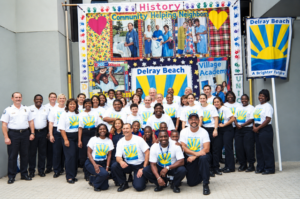
Delray Beach had just won the All-America City Award in Atlanta — our second — and I left Georgia and took my family somewhere to get lost for a few days.
But we learned that there was going to be a celebration on the grounds of an old house on Swinton Avenue that had a big lawn.
We looked at each other and started packing.
That’s the part I keep coming back to; not the award. The packing. Nobody had to convince anybody. My family cut a vacation short because we didn’t want to read about the celebration in the paper or hear about it later. We wanted to be there. With our neighbors. We couldn’t imagine being anywhere other than home with our friends.
I’ve been thinking about why we felt that way.
The lawn that night was full. People who had made the trip to Atlanta and people who hadn’t. People who had worked on the application for months and people who couldn’t have told you what an All-America City was the week before. Kids everywhere. Nobody checking a program because there wasn’t one.
What I remember most is how long people stayed. They stood on the grass in the warm evening air and talked, and the talking was the thing. We had gone to Atlanta to tell a panel of judges what kind of city we were. But standing on that lawn, we weren’t telling anyone anything. We were just…being it.
Around that same time, in the early 2000s, the city commission started hosting community dinners at the Old School Square fieldhouse.
The formula was almost embarrassingly simple. Pick two neighborhoods — different parts of town, different histories, people who would likely never otherwise sit at the same table. Invite them to dinner. Potluck. No agenda.
That last part mattered more than anything else.
No agenda.
Not a listening session, not a charrette, not a strategic planning exercise dressed up with casseroles. Just dinner and fellowship, which is an old-fashioned word I’ve never found a replacement for.
I was in government then, and government is agenda. Government is action items and public comment and three-minute limits at the podium. I believed in all of it — still do, I think, who knows. It no longer matters as much to me. Other things have come to fill my life.
But I watched something happen at those dinners that never happened in a commission chamber.
People from neighborhoods that had every reason to see each other as strangers — or worse, as competitors for the same scarce attention — passed dishes down long tables and discovered they wanted the same things. Safe streets. Good schools. Somewhere for their kids to be kids. A place where someone would notice if they went missing from their routines.
Safe places for our families. A community where everyone has a chance to thrive. That’s it. That’s the whole list.
Nobody announced this discovery. There was no facilitator with a marker asking us to identify shared values. It just surfaced, the way it does when people eat together, in the small talk that turns out not to be small at all.
I read a piece recently about a backyard concert in another town — three hundred neighbors, folding chairs across three yards, a host whose roots ran generations deep. The writer marveled at how easy it was. Nobody had to sign up or agree on anything. There was simply a reason to gather, and a place to do it.
I felt every word of that story. And it sent me back to that lawn, and that fieldhouse.
Here’s what I can’t stop thinking about. In my years in public life, we spent real money and real effort trying to build community — programs, initiatives, plans with tabs and appendices. Some of it worked. But the moments I’d point to now, the ones that changed how this city felt about itself, cost almost nothing. A lawn. A fieldhouse. Covered dishes. A reason to gather and a place to do it.
Did we build those moments, or did we just get out of their way?
I honestly don’t know. Maybe the best thing an institution can do is set the table — literally set the table — and then stop talking. Maybe trust isn’t something you can program. Maybe it’s something that happens to people while they’re passing the green beans.
What I know is this: at the end of those dinners, the fieldhouse emptied slowly. People lingered by the door the way they’d lingered on the lawn on Swinton, finishing conversations that didn’t want to end. Somebody’s dish went home lighter than it came. Somebody who arrived a stranger left with a phone number on a napkin.
Twenty-some years later, I couldn’t tell you a single agenda item from that era.
But I can still see the lawn. And I miss it.
Note:
I find I’ve been thinking a lot about Dolly Parton since she passed. We lost a true legend August 25. Dolly Parton was 80 and she packed a lot into those years.
By the time Dolly Parton died on Tuesday, August 25, at the age of 80, her Imagination Library had delivered more than 332 million books to more than 3 million children.
“When I was growing up in the hills of East Tennessee, I knew my dreams would come true,” the Imagination Library website reads. “I know there are children in your community with their own dreams. They dream of becoming a doctor or an inventor or a minister. Who knows, maybe there is a little girl whose dream is to be a writer and singer. The seeds of these dreams are often found in books and the seeds you help plant in your community can grow across the world.”
When children age out of Dolly’s Imagination Library, they receive a final letter from her hoping they would “have a great time” in school and urging them to keep reading.
The letter ends: “You and all of your friends are very special. There is no limit to what you can do or how far you can go. Just remember the lessons my family taught me—dream big dreams; learn everything you can learn; and care for all those who care for you. You do all of these things and you can be anyone you want to be.
“You are terrific, and remember…
“I Will Always Love You.”
We need more Dolly Parton’s in our world.
Speak Your Mind