My Friend The Pioneer: A Personal Tribute

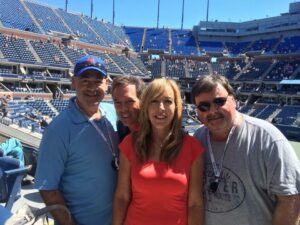
Linda, her brother Howard, Scott and me at the U.S. Open celebrating our 50th birthdays.

My friend Linda Cohn announced her retirement from ESPN last week after 34 incredible years.

Because she’s been an important trailblazer for women in sports journalism, Linda’s announcement was big news.

But long before Linda Cohn became a household name — before the record 5,500 SportsCenter broadcasts, before the National Sports Media Hall of Fame, before she was the most prolific anchor in ESPN history — she was my friend Howie’s older sister. His cool, very cool, big sister. I’ve always admired her.
Linda was a terrific athlete, had a great sense of humor and impeccable taste in music and never made us feel like we were in the way.

Howie (now Dr. Howard Cohn) and I were born a week apart. So, we often celebrated our birthdays together with a visit–accompanied by our good friend Scott– to an amusement park near Amityville off the Long Island Expressway.

Amityville became better known for a horror movie bearing its name, but to us it was home to a place full of rides and arcade games. Linda or her dad would often drive us.

She also took us to concerts. One memorable show was the Doobie Brothers at Nassau Coliseum.

We scored great seats because Howie and Linda’s mom worked as a store nurse at Macy’s. Her office was next to what I think was called the “ticketron”, which meant we had an “in” to score tickets to the best shows of the day. Billy Joel at the Garden, Foreigner and Johnny Winter also at the Garden, Styx at the Coliseum. It was the 70s, and rock ruled the land.


My memories of Linda from those days are vivid. She knew more about sports than anyone, loved the Knicks, Rangers, Mets and Giants, played goalie on an ice hockey team and was an awesome tennis player.

Yes, Linda was cool. She also had a great laugh, put up with our jokes and never seemed to be annoyed when forced to hang out with us. And folks, we could be annoying.

One time, we went to see Beatlemania at the Winter Garden Theatre on Broadway. We went with Linda and my friend’s Scott’s big sister and probably somebody else. Being young and foolish, we wanted some distance from these older women, so we sat in another car on the Long Island Railroad on the way to Penn Station.

When we heard the conductor announce Penn Station, we got off the train, only it wasn’t Penn Station. It was the stop before. The big sisters watched in horror as the train pulled away with us standing on the podium. Eventually, we reunited in the actual Penn Station. I don’t remember their reaction, but I think they were forgiving. I’m also pretty sure we stayed together until we returned safely to Stony Brook.

There were more trips and experiences. We went to Central Park when John Lennon was killed in 1980 for the vigil. That was unforgettable.

We also visited SUNY Oswego, where Linda played on the hockey team and studied broadcast communications.

My memories are her always laughing with us.

That’s the thing about knowing someone before they become someone.

You carry a version of them that the world never gets to see. The Linda Cohn who became a pioneer for women in sports journalism is the same person I watched grow up — or rather, the person who watched us grow up, shepherding a bunch of younger kids around Long Island with the patience of someone who probably had bigger things on her mind already.

She started at WALK-AM/FM in Patchogue N.Y. in 1981, covering news and sports. By 1992 she was at ESPN, and the rest is television history. But numbers don’t really tell the story. What Linda did was simply show up, every night, and treat sports like it mattered — because to her, it genuinely did. As mentioned, she was a former college hockey goalie. She wasn’t performing enthusiasm. She had it.

For those of us who spent decades watching SportsCenter, Linda was the constant. Generations of kids fell asleep to her voice recapping the late scores. And quietly, without making a crusade of it, she was showing a generation of young women that the anchor desk belonged to them too.

She said it herself, in her retirement statement: “What I’m most proud of is that my career lasted long enough for me to see little girls grow up watching SportsCenter, enter this business and succeed in it.”

That’s the whole thing, right there.
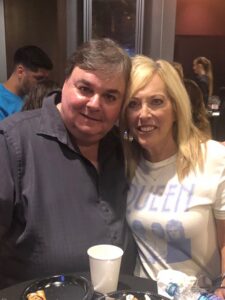
At a Queen concert in Sunrise, Florida.


When Howie and I turned 50, Linda did something I’ll never forget. She treated us to a sports weekend in New York City, access to the ESPN box at the US Open, sideline passes for a Giants preseason game (we were a few feet from Tom Brady and he waved to her), up close at a Mets game. It was one of those weekends that reminds you how lucky you’ve been with the friends you’ve collected across a lifetime. She could have made arrangements for us and said have fun, but she came with us instead. We got to hang out and joke all weekend. It was a magical time.

The teenager who drove us to concerts became the woman who changed what sports television looked like. But she never seemed to forget where she came from, and she never stopped bringing people along with her.

In recent years, we attended a Queen concert in Sunrise (just like old times) and met for dinner at La Cigale in Delray Beach.

There are texts, mostly during football season, where all of us lament life as Giants fans.

We share photos of people we used to know, poke gentle fun at the world and follow each other on social media.

Recently, Linda did a great podcast with Rich Eisen as part of his series “That was SportsCenter.”  Don’t miss it, it’s awesome. Here’s a link https://www.youtube.com/watch?v=8hGFBz5iv7k

Linda has met all the legends in just about every sport. Walking around NYC with her was a trip. She was stopped for photos etc., and my friend Scott photo bombed every single one.

And we laughed. How cool is that?

Linda, congratulations on a career that mattered. You earned every one of those record setting broadcasts and inspired a generation of women entering sports journalism. Wow.

And thanks for the rides too. Can’t wait to see what the next chapter holds.

Walk Like A Man

My father Sandy.

There’s a Springsteen song I keep circling back to this time of year.

Not one of the anthems — not “Born to Run,” not “Thunder Road.” A quieter one, off  the album Tunnel of Love, called “Walk Like a Man.”

It’s about a son standing at the threshold of his own grown-up life, thinking about the man who taught him how to stand. Bruce isn’t singing about a hero in the comic book sense. He’s singing about a father. About a boy who watched his dad move through the world and then spent the rest of his life trying to match the stride.

That’s the song I’d play for my father, who turned 88 last week.

My dad was a pharmacist. Had his own store — Maple Pharmacy in Smithtown, N.Y.

If you’re under a certain age, you may not understand the importance of an independent pharmacy, because we’ve mostly traded it away, although Maple Pharmacy still exists, the oldest pharmacy in that corner of Long Island.

During my dad’s career, the independent pharmacist wasn’t a clerk behind a counter. He was a fixture. He knew your name, your mother’s name, which kid had the ear infections and which one couldn’t take penicillin. He was the guy you called when the baby spiked a fever at ten o’clock at night and you weren’t sure whether to panic. Half medicine, half ministry. People walked in scared and walked out feeling better because people like my dad came around the counter and gave them comfort.

“The baby is going to be just fine.”

“Put this on and the itch will go away.”

“Don’t worry, but you need to have that looked at.”

When I was born, my dad, still newly wed and 26 years old, owned a store in Whitestone, Queens. He and my mom lived across the street. I was told that customers would knock on their door late at night seeking medicine.

It was a lot for a young man. A lot for a new dad and a new husband. But my mother used to tell me that my father was kind to everyone.

That’s my father.

What I remember growing up was the steadiness. He went in every day and did his job well. He worked long hours under fluorescent lights, trapped behind a counter filling prescriptions the old-fashioned way, with a mortar and pestle. The mortar is the heavy bowl and the pestle is the blunt club shaped tool that he used to grind and mix the concoction. It was pretty cool. This is before medicines arrived pre-packaged.

While the store was busy—people coming in for greeting cards, magazines, toiletries and assorted stuff– my dad was usually alone behind the counter. He told us that he longed to be out front where you could kibitz with the customers rather than in back filling prescriptions and typing out labels (the hunt and peck method). This was before computers and mail order pharmacies, before chains ruled the landscape and back when doctors would call in prescriptions.

I don’t know how he kept it all straight. But he did.

He didn’t do it for applause — there wasn’t any. There’s no parade for the man who fills the prescription correctly, who locks up every night, who comes home and is fully present for his wife and his kids.

Although I will say that when my dad came home, my mother made sure his newspaper was near his chair and that my sister and I weren’t doing anything loud or wild. We had a dog named Tina, a Beagle dachshund, who behaved like a person. She would keep his chair warm until he arrived. When he walked in, she greeted him and followed him back into the den to stand guard.

Tina got hit by a car one day. Happened right in front of me. I was playing football on the lawn when a kid opened the fence and Tina took off chasing a cat. A lawn truck coming down the street swerved to avoid the cat and hit our dog. I can still see the scene in my mind.

We put Tina in a cardboard box and my mother called my dad at the pharmacy. He came home and I went with him to the vet, all the while praying she would be ok. She looked peaceful, as if she was sleeping. I will never forget when the vet said she was gone. That night was the first time I ever saw my father cry. I will never forget that either. I was 9 years old.

My dad is a strong person. I’ve seen him overcome obstacles that would have crushed another person. Along the way, I watched, I’m not sure he knew that, probably not. But I watched and I absorbed daily lessons.

How he treated my mom. How he was supportive of my sister. How he visited neighbors suffering from cancer. How he honored and taught us to love and adore our grandparents who came here fleeing tyrants, sacrificing everything so we could have a better life.

I watched him tackle handyman projects, build a business, join a pool club so we could run around and play during endless summers. I watched him come home every night directly after work, never stopping for a drink with the guys like many other fathers did.

He took us on modest but super fun vacations, made sure I could take tennis lessons during the winter months because I had shown some promise and didn’t say a word when I lost interest in high school and moved on to other things namely girls, friends and old Mustangs.

I saw him get up every day, work hard, treat everyone well and repeat for a lifetime.

We don’t hand out medals for that. Maybe we should. Because that quiet, unglamorous reliability is the actual load-bearing wall of a family and a community. Everything else — the institutions, the civic life, the trust we keep complaining we’ve lost — it all rests on people like my dad, doing the right thing when no one’s keeping score.

That’s the kind of hero I want to write about this Father’s Day.

Not the loud kind. The everyday kind. The men who built a good life one ordinary, faithful day at a time, and never thought to call it heroism because to them it was just what you did. It was what his father did after coming to this country in 1920 with no money, no knowledge of English and no one to help him. His son, my dad, went to an Ivy League school and built a successful business and a happy family. That’s the American Dream. Work hard, do the right thing and you shall be rewarded. We ought to ask ourselves if that’s still the case. And if not, why not? What can we do to restore that beautiful promise?

As mentioned I studied my father when I was a kid.

I watch how he carried himself. How he handled life. What he did with his savings. How he derived pleasure from family, a fish tank and a set of tennis (now golf and bocce).

And I’m still studying him now, in my sixties, except now I understand the assignment. The Springsteen song gets at it exactly: you watch your father walk, and you measure your own steps against his, and the great hope of your life is that if your dad is a good man, you turn out to walk a little like he does.

Don’t get me wrong, my dad isn’t perfect (but he was darn close). No good father in any honest story is. But he was constant, and I’ve come to believe constancy is the rarest thing we’ve got. Anyone can be good on the big days. He was good every day.

So, here’s to my father and to all the quiet men like him — the ones who showed up, did the right thing, loved their people, and asked for nothing back. The everyday heroes. The ones who taught us how to walk like man.

I can still picture the store, my dad behind the counter, people lined up for a word of advice. I can still see us as at the pool club, me small, trailing him toward the tennis courts, taking two steps for every one of his, trying to keep up. I’ve spent my whole life trying to keep up.

My Generation

As this pandemic goes on and on, I’ve been struck with a recurring thought: I’m so glad I grew up when I did.
I’m a child of the 70s and 80s which means a few things.
I grew up with great music.
I experienced drive ins.
I saw ET, Rocky, Jaws and Animal House in the theater.
I remember watching the Watergate hearings on TV and saw elected leaders put their country over their party. Can you imagine that?
We watched Walter Cronkite every night, read an actual newspaper every day and believed what we heard and read. Why? Because it was true.
My friends and I played outside until it got dark. My parents didn’t feel a need to hover, they knew my sister and I were safe in our neighborhood.
We knew our neighbors, every single family on the block, and we looked out for one another.

I remember when a neighbor’s house caught on fire and we stood on the lawn watching the blaze and were scared that the house may burn to the ground and that our friends would be forced to move away. We cared for each other genuinely.
As pre-teens we roamed the mall, soon to be a relic of the past, visited bookstores (remember those) and saved our money to buy record albums (vinyl!) and baseball cards.
We didn’t keep the cards in pristine condition or look at them like investments.  We flipped them, traded them, put them in the spokes of our bicycles and memorized the stats on the back. We even chewed the bubble gum inside the packs even though it tasted like cardboard—dusty cardboard.

We took the Long Island Railroad to the city and wandered Manhattan and saw some things that… well …helped us grow up.
We bought old cars for little money. Rusty Mustangs and Cougars and we even managed to appreciate the unique design of the AMC Pacer—which in our optimistic eyes looked like a short squat Porsche.
We went to dances, proms, comedy clubs and Broadway shows which were affordable back then.
We went to Shea and Yankee Stadium and truly believed that the “Magic was Back.”  (It wasn’t).
Our friend’s mom worked as a store nurse for Macy’s (do they have those anymore—store nurses that is, Macy’s seems on the way out too) and she made sure to reserve us concert tickets which were $8 back then.

We saw Billy Joel, The Doobie Brothers, Styx, Aerosmith and a slew of other classic bands. We once slept outside to get tickets to see The Police at Shea Stadium only to get seats just below heaven. We didn’t care, we were there and that’s what mattered.
We had fake ID’s and we snuck into bars and it felt exciting. We could get caught. But we never did. And every time we got past the burly bouncer we saw another kid that we knew wasn’t quite of age.
We spent hours shooting hoops, throwing around a baseball or a football and trying to hit a spaldeen ball with a stickball bat over the roof of the neighbor’s house.
We listened to music, shared pizza and talked about what we were going to do with our lives.
There were no texts, no social media, no Tik Tok videos but we did have MTV when the station actually played music.
Can you imagine?
Last night, I shared 90 minutes of Zoom laughs with five guys who were there for it all.

Dave, who biked to my house to trade baseball cards when he was five and I was six. We’ve been friends ever since.

Joe, whose dad owned the pizza place with the best thin slices. New York style.
Greg, who drove a Dodge Dart Swinger and was our designated driver.
Scott, the Mets and Giants fan, who could hit the ball over the roof.
And Howie, whose mother was the store nurse and who had an older sister who would drive us around and talk sports with us. She would later become a famous pioneering sports journalist at ESPN. But to us she was the cool older sister with the driver’s license who thought we were funny.
When we speak via Zoom these days we gather from Southern California, Northern Virginia, New Jersey, Raleigh, N. C., South Florida and Stony Brook, N.Y.
Our conversation these days is focused on current events and we argue—politely. But those arguments always end with “hey, I still love you guys” which could be a lesson for all of us.
And we do.
There’s too much history and too much in front of us to ever walk away from each other over how we differ in our views of a virus.
I see the men these guys have become—all successful in their own ways every time we talk.
But I still see the boys we were too and that connection to the past is critical.

 I remember conversations from 1979 when a few us pledged to stop being so shy around the young women we liked.
That conversation prompted me to finally ask for a date with someone I had a crush on for years.
I was so nervous that I did not remember what she said when I asked. I walked away from her so nervous that I literally had no idea what she said.
Apparently, it was a yes because a day later she said she couldn’t go out because she was going fishing with her uncle or something. I never had the courage to ask again.
My supportive and sensitive friends responded by printing T-shirts of people fishing with a cutting remark underneath the graphic. Hey, this stuff makes you resilient. So thanks guys.

Anyway, we talked last night about how we feel so sorry for kids today. Cut off from their friends and girlfriends, denied proms and graduation ceremonies and unsure if they will be going off to school in the fall or if they will be cracking open their iPads.
One of my buddies kids is in limbo about college and another just had two boys graduate college and grad school only to enter a scary job market.
Sigh.
You wonder and you worry how this will impact a generation.
As I said, I’m grateful to have grown up when I did. We didn’t have much in the way of technology but we had each other. Still do.

Deadline Artists

Russell Baker was an inspiration to a generation of journalists.


These last few weeks have been special for those of us who love newspapers.

The great newspaper reporters were being celebrated and it was wonderful to read about their exploits.

Sadly, the great Russell Baker passed away at the age of 93, but his passing led to an outburst of writing and appreciation by those who loved his work.

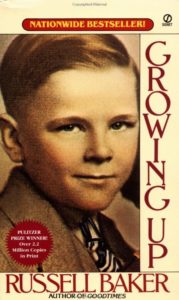
The best selling author of “ Good Times” and “Growing Up” and a long time New York Times columnist, Russell Baker was an American original. His writing sparkled with insights and humor. They just don’t make em like Russell Baker anymore.

On the heels of Baker’s passing,  HBO released a documentary called “Deadline Artists” which chronicled the colorful careers of New York tabloid legends Pete Hamill and Jimmy Breslin.
They broke the mold when they made those guys.

Breslin wrote legendary stories on the JFK assassination and the Son of Sam killer by veering away from the pack and finding angles that other reporters missed.

That’s not an easy thing to do.

For instance, how do you stand out from the horde of reporters covering that fateful November day in 1963?

Answer: You find the doctor who treated the president and glean all sorts of details about his day before he gets the fateful call that would change history. What did he eat for lunch? What was he doing and thinking right before being called to do the impossible: save a gravely wounded president. That’s how you file a story that adds to the record and humanizes history.

As for Hamill, well he was dashing and lived a large life in a large city.

All three journalism giants practiced their craft during a golden age for newspapers in New York when the Times, Post, Herald Tribune and Daily News carved up New York and covered every square inch of the Apple.

I read book after book about this era of newspapering because newspapers were my first professional passion and frankly I couldn’t get enough information on those days and those characters.

I grew up with Newsday and my local weekly the Three Village Herald, a paper I would later write for—albeit briefly.

I caught the last great wave of the newspaper life working for papers in upstate New York and right here in Delray and Boca.

I shared newsrooms with people who worked for some truly great papers and some supermarket tabloids too.

They all had great stories.

About life.

About life on deadline.

About mistakes they made.

About scoops they scored and scoundrels they nailed.

There was just no better place to spend a day than a newsroom with creative people who wrote, edited, designed, photographed and ultimately glued and pasted the stories of this community on great big “flats” before they were sent downstairs to run on the great big offset presses that were just awesome.

The pay was terrible. The stress could be crazy. The deadlines stressful and the sources weird, wacky and wonderful but what a job!
You went out and found stories. You came back to the newsroom and told them.

Nobody told them better than Baker, Breslin and Hamill.

They were gold standard we strived to match but never did.
But my oh my did we have fun trying.

Homeward Bound

Beautiful Port Jefferson, N.Y.

This is a hyperlocal blog focused primarily on Delray Beach and Boca Raton.
But we also focus on cities, leadership, entrepreneurship and the general notion of community; what it means and how to build it.

So in the spirit of exploration I wanted to share with you some thoughts after a recent and all too brief trip “home” to the Port Jefferson/Setauket/Stony Brook area.
It’s where I grew up on eastern Long Island after being born and spending a few years in Queens.

It’s a beautiful area, magical in so many ways.

The older areas are truly historic with buildings dating to the late 1690s and early 1700s.
The area played a key role in the Revolutionary War with George Washington’s Setauket spies doing important work to defeat the British. Those days were recently depicted in a TV series and information about the spy ring is written on plaques and available on apps that give an oral history of the area.

We never lived in the historic parts of these towns, although we appreciated the older homes, wooded environments and colonial architecture.

My family and most of my friends lived in Levitt Homes, tract housing developed by the builder who invented suburbia after World War II.

Today, those homes are 50 years old plus and when I drove to see  a few of our old house (we moved around a lot) I could see the age on what was once so new. I enjoyed seeing the mature trees and for the most part the Levitt “sections” –as they were called— have held up well.

They are lovely in their own way and each street is filled with memories of community back when neighbors knew each other and when kids played outside until dark.

It was a magical time and we lived in a magical place. And as I shared with a best friend who grew up there with me, I’m grateful for the time spent here and saddened by the time that has passed.
I’m not sure when I will come back to Stony Brook. But I’m pretty sure that I will.

I feel very connected to the place.

It is and will always be home. The place where I went to school, where I lived with my parents and sister, where my grandparents (long gone but never forgotten) visited and where I met the best friends I’ve ever had and we experienced life’s adventures for the first time.

School days and favorite teachers and first crushes.
Parties and bar mitzvahs.
Little League, pick up basketball, stickball and football.
First cars, first loves, first everything.
Then, one day it ends.

And you go off—as you should– to explore new places, new experiences and new people.
But you never completely leave home and the experiences and the people that shaped you.

These are the people who support you, challenge you, push you and pick you up when you stumble and fall—as we all do.
I felt compelled to come home when I turned 40 and wanted to show a new love where it was that I came from. I thought if she saw the places that accompanied the stories and the personal history that we would grow closer and I think we did. I was also anxious to visit her hometown, Clairton, PA., a hardscrabble kind of place that explains a lot about who she became.

Fourteen years later, almost to the day, I felt compelled to return to my hometown.
I’m not sure why. Maybe its just important to touch —albeit briefly—your roots.
Your roots are what center and ground you.

I guess I needed a dose of home.