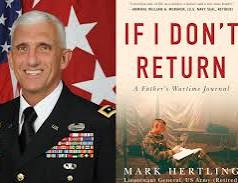
I recently came across a new book by retired Lt. Gen. Mark Hertling, If I Don’t Return: A Father’s Wartime Journal.
Hertling began writing the journal for his two young sons while serving in the Gulf War. He was given orders and the intelligence briefing was grim. His unit could lose 50 percent of its personnel. Can you imagine?
Hertling wasn’t sure he would come home. So he started writing down the things he wanted his sons to know if he didn’t.
That’s a pretty powerful premise.
Not a will. Not instructions about money or possessions.
A record of what a father believed mattered.
The book got me thinking about the things I would want to tell the people I love. What I would tell my children.
And the things I wish I had understood earlier.
Hertling’s lessons aren’t particularly complicated. Character matters. Trust matters. Family matters. Service matters. Be courageous. Admit your mistakes. Pay attention to the people around you. Don’t confuse success with a meaningful life.
But one idea hit me particularly hard:
Don’t spend so much time preparing for the future that you fail to live in the present.
That lesson got to me; I’ve spent a lot of my life looking ahead.
I would describe it as ambition. Drive. Restlessness.
And I’m proud of some of what that produced. I worked hard. I took risks. I built things. I went into business. I got into politics. I pursued opportunities. I cared deeply about doing things that mattered.
But there was a cost to all of it. Perhaps that’s inevitable but at the time I never did the math.
I never asked myself whether it was worth it.
I was always thinking about what was next.
And sometimes “what’s next” became more important than “what’s now.”
I didn’t fully understand that until I thought about my children.
There was a year when I spent a concentrated amount of time with my daughter, Samantha.
She was little. My ex-wife’s job demanded crazy hours, so Samantha spent her days in childcare and I spent mine in a newsroom.
But the early evenings were ours.
I fed her dinner.
That’s the memory.
There were no profound conversations. She was too little for that.
She was just cute.
So was our enormous golden retriever, Magnum, who would sit nearby, waiting patiently for the inevitable scraps to fall from the high chair.
It became a ritual.
Samantha eating dinner.
Magnum waiting.
Me feeding her and trying to make her laugh.
Nothing particularly remarkable happening.
I even filmed some of it with an old-fashioned video camera.
I’m glad I did.
Because now, years later, I understand something I didn’t understand then.
That was the good stuff.
Not the important meeting.
Not the next opportunity.
Not the next campaign.
Not the next accomplishment.
Dinner.
A little girl being cute.
A giant golden retriever waiting for a scrap.
An ordinary evening.
I never had that same concentrated year with my son when he was little.
I went into business. It was a struggle. Then I got into politics, and politics was consuming.
There was always something that needed to be done.
Something important.
Something urgent.
Something next.
And then my son grew up.
You can’t slow it down.
That’s the part I wish somebody had explained to me.
You can work harder tomorrow.
You can take another opportunity.
You can start another business.
You can run another campaign.
You can accomplish another thing.
But you can’t ask your child to be eight again.
You can’t go back and have the Tuesday night you missed because you were chasing something that seemed so important at the time.
That’s not an argument against ambition.
I don’t regret being ambitious.
It served me well. Ambition helped shape my life. Some of the things I’m proudest of probably wouldn’t have happened without it.
But I wish I had understood earlier that ambition and contentment aren’t opposites.
You can want more from your life and still appreciate the life you have.
You can be ambitious about tomorrow without being impatient with today.
That’s something I didn’t always know how to do.
Hertling’s book has me thinking about another of his ideas: that legacy isn’t simply what you accomplish or leave behind. It’s what you leave in other people.
I’ve spent a fair amount of my life thinking about what I would leave behind.
Maybe I should have spent more time thinking about what I was leaving in people.
The kindness.
The conversations.
The example.
The memories.
The dinners.
The ordinary Tuesdays.
Those things don’t show up on a résumé.
They don’t win awards.
Nobody gives you recognition for them.
And maybe that’s the irony.
I spent years chasing recognition.
What I really wanted, I think, was to know that I mattered.
But the older I get, the less interested I am in being recognized and the more interested I am in being remembered by the people who actually matter.
Not for the titles.
Not for the accomplishments.
Not for the things that seemed so urgent at the time.
Maybe just for being there.
For the dinners.
For the laughter.
For the ordinary moments that didn’t seem like much when they were happening.
Because those moments were happening to us only once.
And you can’t slow it down.
You can’t get them back.
So maybe that’s the lesson I’m taking from Hertling—and from my own life:
Don’t stop reaching for what’s next.
Just remember to look at what’s in front of you while you’re doing it.
Because someday, what’s in front of you will be behind you.
And you’ll realize it was the thing you should have been paying attention to all along.