Driving Around These Parts…

I try not to be a scorekeeper.

I really try.

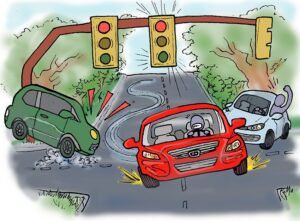
But lately I’ve been keeping score of how many near misses I experience while driving to and from work in downtown Delray Beach.

Last week, the score was 14 near misses, that’s more than two a day since I work 5 days a week. Mind you, I work three miles from my home. And I don’t go anywhere near I-95 when I “commute.”

It’s gotten dangerous around here my friends. I know I’m not alone in that assessment.

I thought I’d share my experience in the spirit of—oh OK—venting.

I’m calling this essay “Surviving Delray Beach: A Driver’s Field Guide to Urban Combat”.

Let me be clear: there are many things to recommend about Delray. The restaurants, the vibe, the ocean — all magnificent. But the moment you get behind the wheel anywhere near Atlantic Avenue, you are no longer a driver. You are a contestant. Welcome to the game. Nobody told you the rules because there aren’t any.

Here’s a field guide to some of the hazards you’re likely to encounter.

The Pedestrians Who Don’t Need Traffic Signals


Somewhere along the way, the crosswalk signal became advisory in Delray. Merely a “suggestion”, like the “suggested donation” at a museum — acknowledged, considered, and promptly ignored.


The Delray pedestrian does not wait for the little white walking man to appear. That little white walking man is for other people. People from, I don’t know, Ohio.

Instead, our Delray pedestrian steps into the street with the serene confidence of someone who has already made peace with their mortality and is just trying to get to City Oyster before it gets crowded.


They don’t look at you. That’s the key detail. They look through you or at their phones. You are the obstacle. They are the destination. You will wait.


And you know what? You do. Because they’re already halfway across the street anyway and it’s too late to honk. But oh is it tempting.


The Green Light: A Color That Has Lost All Meaning


Here is something the Florida Department of Transportation did not account for when they engineered traffic signals: the smartphone.


The light turns green. You wait. Nothing happens. You wait some more. Still nothing. You begin to wonder if you’ve died and this is your personal purgatory — a stretch of Atlantic Avenue or Swinton that never actually moves. Then, gently, almost apologetically, the car in front of you lurches forward because the driver has finally — finally — concluded whatever they were doing on their phone.


What were they doing? Nobody knows. Texting? Checking Instagram? Reading a deeply important email from a local blogger?  Making a stock trade? Rewatching a TikTok they’ve already watched twice?

The content doesn’t matter. What matters is that the light has now been green for eleven seconds and you have collectively traveled four feet.

The technical term for this is “distracted driving.” The local term is “Tuesday.”


Federal Highway: Now Featuring Bonus Lanes Going In Both Directions


Federal Highway is a road running straight through the heart of Delray. It has clearly marked lanes, clearly marked directions, and a meaningful percentage of drivers who are operating in complete defiance of both.


I do not know what causes someone to decide that the southbound lanes are, for their purposes, northbound. I have theories. Maybe their GPS gave up. Maybe they’re from a country where this is standard. Maybe they’ve simply been to Too Many Brunches and things got directionally fuzzy after a few mimosas. Whatever the cause, the effect is the same: a car coming straight at you in a lane you were reasonably certain was yours.

The correct response is to brake, swerve gently, and take several deep breaths. The tempting response is to ask, loudly and alone in your car, what on earth is happening. Both responses are valid. Neither fixes the problem.


The E-Bike: Safety Optional


The electric bike has transformed Delray Beach. People who once would have had to interact with traffic only occasionally can now interact with it constantly and at surprising speeds.


The Delray e-bike rider operates in a fascinating middle space between bicyclist and vehicle — subject to the laws of neither, governed only by an invisible code of risk taking. They will dart out of a side street without looking. They will cut across two lanes while on a phone call. They will appear, fully formed, from between two parked cars as if conjured by the universe specifically to test your reflexes.


And they are fast. This is the part that catches you. You expect a bicycle. You get a bicycle that has had a very important conversation with electricity, and the result is a two-wheeled projectile doing 25 mph through a gap that a sensible person would not walk through.


They also usually get away with their daredevil behavior. E-bike riders in Delray have developed a kind of chaos immunity. It’s impressive, honestly. Infuriating, but impressive.


The Guy on the Regular Bike Downtown


There is one specific man — and I believe it is always the same guy, though I cannot prove this — who rides a regular bicycle through downtown Delray as though he is auditioning for a role in a film about a person who has never seen traffic before.


He weaves. A lot.

Left, right, then left again, threading through moving cars with the unhurried grace of someone who decided long ago that traffic lanes are aesthetic rather than functional. He has no helmet. He may or may not have hands on the handlebars — this varies by observation. He is relaxed in a way that triggers something primal in everyone watching him.

Cars swerve. Drivers gasp. And he glides on, indifferent, peaceful, somehow always fine.

I think he might be a kind of civic spirit. A guardian of chaos. Delray’s answer to the sphinx — a riddle at the center of things, never fully explicable, always present.


A Word of Encouragement


Here’s the thing: once you accept that driving in Delray Beach is participatory theater, it becomes almost enjoyable. Almost.

You stop fighting the pedestrians and start marveling at their boldness. You stop being annoyed at the green-light daydreamers and start appreciating that we live somewhere leisurely enough that people can afford to be that distracted. You start clocking e-bike riders the way birdwatchers clock birds — oh, there’s another one, look at him go.

Federal Highway wrong-way drivers remain inexcusable. I can’t spin that one.

But the rest of it? It’s Delray. It’s loud, slightly unhinged, and completely itself. Buckle up, pay attention, and for the love of all that is good, do not assume that a green light means go.


It means probably go—just as soon as the driver in front of you looks up from their phone.

Note: The author survived the writing of this piece and three trips down Atlantic Avenue this weekend.

Change

change

You are never FINISHED

“By nature good public spaces that respond to the needs, the opinions and the ongoing changes of the community require attention.  Amenities wear out, needs change and other things happen in an urban environment. Being open to the need for change and having the management flexibility to enact that change is what builds great public spaces and great cities and towns”–Project for Public Spaces 11 principles for creating great community spaces. Note: Founder and President Fred Kent has a home in Delray Beach.

The Project for Public Spaces is spot on, as they always seem to be.

The best part of cities is their changing nature. Cities evolve. Places change. That’s the beauty of an urban environment, it’s never stale. And switched on cities know this, embrace this and seek to shape and ride the waves of change.

We are witnessing tremendous change in Boca Raton these days. Just cruise on over to Palmetto Park Road and you’ll see large scale development taking shape on what I’ve always found to be an interesting but underperforming street.

The nature of the development is not everyone’s idea of healthy growth but there’s no question that Boca is evolving before our eyes. And I’ve talked to many people who love what they’re seeing. Development and change will always be a mixed bag. Beauty is in the eyes of the beholder as they say.

On Military Trail, the Moderne Boca is taking shape and its nice to see some attention to design in a western location.

FAU Research Park is booming under the capable leadership of Andrew Duffell.  Both FAU and Lynn are coming of age as innovative institutions of higher learning and the Park at Broken Sound  is sprouting three new residential apartment projects (1,050 units) to go along with office space and new retail in the 700 acre business park. With yoga rooms, pet facilities, a Fresh Market, putting greens and Zen Gardens, the former home of IBM is shaping up to be a true, live, work, play destination.

It’s an interesting time.

And a time when visionary public officials have an opportunity to work with the community and design spaces that can become great public spaces.

In Delray, the opportunities are immense but only if we recognize them and embrace good design and change.

US 1 is looking good these days. And there is tremendous opportunity to extend the downtown north and south along Federal Highway. The idea to narrow the federals and slow down speeding traffic was first broached in 1991 but it took a decade before it became a city goal when it was included in the Downtown Master Plan. It took years to construct, but now that the project is complete, it presents an opportunity to create something special; it’s now a street not a highway. There’s a difference.

The area near Third and Third and South of the Avenue offer great opportunities for infill development.

Congress Avenue also represents an important opportunity for transformation.

My hope is that both Delray and Boca think strategically about placemaking and about what is needed in order to sustain and build on their obvious success.

Any analysis would include honest discussions about what has worked (and how those aspects can be extended and sustained), what’s not working, what can work better (lazy assets) and what’s missing.

Other key discussions should focus on demographics, design, mobility, land uses and how it’s all paid for.

In Delray, that means focusing on what’s important and no more majoring in the minor. (For example, weeks of discussion on a tattoo shop but little or no discussion on how to attract millennials, create more jobs and add middle class housing or how to improve our torturous approval process).

It’s time to move on Congress Avenue, not wait for an outside firm to confirm and codify what 30 plus citizens who studied the corridor for nearly a year already concluded. A sense of urgency is needed to take advantage of the economic cycle.

It’s also time to activate the Old School Park and make it a great public space as was envisioned when voters overwhelmingly passed a bond issue in support of that idea in 2005.

It’s time to bring back discussion of a bonus program for our CBD to jumpstart housing for young professionals who are attracted to downtown living. The best way to support our mom and pop businesses is to encourage people to live downtown. Study after study show that downtown residents strongly support local businesses. As rents soar –threatening to crowd out independents –this is needed more than ever.

Downtown office space is also critical. Every conversation I’ve witnessed with and about entrepreneurs laments the lack of office space in the urban core. This isn’t necessarily a call for class A space, but rather creative space, co-working space and incubator space. It’s nice to see The Kitchn open inside the offices of Woo Creative and Delray Newspaper, but more is needed.

The aim of past citizen driven visions was to build on food, beverage and culture and create a sustainable city driven by creative industries. Delray’s vibrant, urban feel is hugely appealing to entrepreneurs but a lack of space hinders the sectors ability to gain traction in our central business district.

An important caveat to note: the key words are “build on” not jettison or replace. So it would be folly to lose events or culture or our robust food scene, we need an additive attitude because community building is not a zero sum game.

Finally, both Delray and Boca are blessed with abundant human capital. A strategy to retain graduating college students and bring home locals who go off to college while also attracting the best and brightest from other locales will go a long way toward diversifying our economy and growing opportunities. Again, placemaking is at the core but so is opportunity making. We need to create cities of opportunity.

We also need to tap into the incredible knowledge base of our boomer and senior population many of whom long to be creative, active and involved as they age.

Cultivating our human capital is the best economic development strategy we can ever hope to conceive.

When I survey the region, it’s hard not to get excited by the possibilities. Sure there are big problems and challenges. Every single place in America has them. But few regions have our upside potential.

Miami is rapidly taking its place as among the world’s most exciting cities. Fort Lauderdale is making some interesting strides and several other cities in Broward, notably Pompano Beach are well positioned for a renaissance.

Boca is attracting industry and further north Boynton Beach is making some noise with several growing breweries, Hacklab, young leaders, eastern investment and some really cool restaurants (Bond and Smolders, Sweetwater and The Living Room among them) and keep your eyes on 22-year-old Ariana Peters who is quietly accumulating key properties in Lake Worth. Northern Palm Beach County cities, led by dynamic business leaders such as Chamber President Beth Kigel, are working well together on branding and industry recruitment efforts.

It’s an exciting time. Cities can’t rest on their laurels and they can’t succumb to those who want to freeze progress and stop change.

You can do the former but you can’t do the latter. And if you freeze progress you can be sure that the change you’ll see won’t be pleasant. Not at all. It will be ruinous.

As General Eric Shinsecki once said: “If you don’t like change, you’re going to like irrelevance even less.”