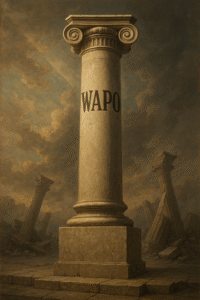
Democracy Dies In Cost Cutting
The Way He Was

Chasing Lightning

I missed the fedora years, but worked with a few reporters from that era.
Mark Twain said finding the right word is like capturing lightning.Sometimes the muse allows you to experience what that’s like. Sometimes the muse goes missing.
These days, I’m chasing lightning. I’m trying to see things, trying to look deeper, trying to slow things down just enough to understand a little bit more. I’m trying to catch lightning and put it out into the world.
I write this blog, have written two books (and sold two copies of those books!) but if you want to write, you write. It doesn’t matter if it sells, you keep putting your thoughts out into the world. And who knows, maybe someday…
I write because I love it. I write because it helps me order my cluttered mind and I write because occasionally I strike a nerve and someone sends me a kind note or stops me at the grocery store and mentions that they liked this or that.
You remember the slings and arrows—they leave a mark. But a kind word is fuel. High octane fuel.
I don’t expect to be James Patterson or Stephen King, I just write for the pure pleasure of it.
Once upon a time I made a living as a journalist. You make very little money, but you learn a little bit about a whole lot of things.I covered business, crime, government, agriculture, education and sports. I wrote feature stories and had a blast doing it.
There’s nothing like working in a newsroom, surrounded by young talent and grizzled veterans. Some of those grizzled veterans liked us newbies and others couldn’t tolerate us. I liked every single one of them. Those that were friendly, became friends and mentors. Those that couldn’t stand the sight of us also managed to teach us —a curse word at a time.
Our city editor when I started writing about Delray was a guy named Tom Sawyer. That was his real name. I was 22 years old when I started at the Monday-Thursday Papers and Tom took me out to lunch on my first day. We went to Tom Sawyer’s restaurant on Boca Raton Boulevard and he told me that the place was named after him. I think I believed him. Tom was slight in stature but loomed large in life. He had a big bark, but a soft heart. He had been around the block many times and would turn beet red when he was mad, which was at least once a day. You never wanted to be the reporter, editor or photographer who made Tom red. He would stand in the middle of the newsroom and cover his eyes with his hands waiting for the rage to pass.
I liked him. He was my “Lou Grant” and I knew if I listened he could teach me a lot.
I became especially close to a sportswriter named Jim. He was a terrific writer, immensely gifted but a classic underachiever.He wore sweaters year round, even in summer, had a beautiful dog named Mario and he loved women.I sat next to him in the newsroom and we exchanged copy. I’d look at his stories and he’d look at mine.I was young and trying to figure things out, he was older and experienced. He had style and craft and when I read his stories I knew I had a long way to go. He was good. Real good.He was also troubled.
Sometimes, after work, we’d go to a bowling alley bar off of Cypress Creek Road for a beer. I thought it was an odd location, but I’d follow Jim anywhere thinking that maybe over beers I’d gain a nugget of advice that would make me a better journalist.I soon learned that he went to the bowling alley bar because he had a thing for the bartender who looked a lot like Elvira—Google her and you may remember.He wasn’t exactly there to give me tips, but it was fun anyway.
One evening, the movie “Platoon” was playing at the bar and my cool friend suddenly broke out in a cold sweat. Without taking his eyes of the screen, he recounted his experiences in Vietnam as a medic. His knuckles turned white as he gripped the bottle of beer in his hands. He was riveted by the movie. “This is what it was like,” he said. And then he stopped talking, but in that instant I saw what my friend was wrestling with.
It was an unforgettable moment, and I learned a lot that night. Every experience makes you a better writer. Jim left the paper for a new life in Denver, but he made a lasting impression. I’ve been looking for him ever since.
I left journalism a long time ago, but journalism never left me. The writing part anyway.As we speak, I’m trying to write a play. It’s a stretch for me, the craft requires different muscles but I think challenging yourself as you get older is a good thing. I don’t know if it’s any good, or if it will ever see the light of day, but I’m determined to finish.I’m trying to catch lightning. And I don’t plan to stop any time soon.
Deadline Artists

Russell Baker was an inspiration to a generation of journalists.
These last few weeks have been special for those of us who love newspapers.
The great newspaper reporters were being celebrated and it was wonderful to read about their exploits.
Sadly, the great Russell Baker passed away at the age of 93, but his passing led to an outburst of writing and appreciation by those who loved his work.
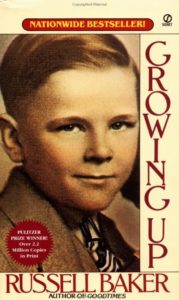
The best selling author of “ Good Times” and “Growing Up” and a long time New York Times columnist, Russell Baker was an American original. His writing sparkled with insights and humor. They just don’t make em like Russell Baker anymore.
On the heels of Baker’s passing, HBO released a documentary called “Deadline Artists” which chronicled the colorful careers of New York tabloid legends Pete Hamill and Jimmy Breslin.
They broke the mold when they made those guys.
Breslin wrote legendary stories on the JFK assassination and the Son of Sam killer by veering away from the pack and finding angles that other reporters missed.
That’s not an easy thing to do.
For instance, how do you stand out from the horde of reporters covering that fateful November day in 1963?
Answer: You find the doctor who treated the president and glean all sorts of details about his day before he gets the fateful call that would change history. What did he eat for lunch? What was he doing and thinking right before being called to do the impossible: save a gravely wounded president. That’s how you file a story that adds to the record and humanizes history.
As for Hamill, well he was dashing and lived a large life in a large city.
All three journalism giants practiced their craft during a golden age for newspapers in New York when the Times, Post, Herald Tribune and Daily News carved up New York and covered every square inch of the Apple.
I read book after book about this era of newspapering because newspapers were my first professional passion and frankly I couldn’t get enough information on those days and those characters.
I grew up with Newsday and my local weekly the Three Village Herald, a paper I would later write for—albeit briefly.
I caught the last great wave of the newspaper life working for papers in upstate New York and right here in Delray and Boca.
I shared newsrooms with people who worked for some truly great papers and some supermarket tabloids too.
They all had great stories.
About life.
About life on deadline.
About mistakes they made.
About scoops they scored and scoundrels they nailed.
There was just no better place to spend a day than a newsroom with creative people who wrote, edited, designed, photographed and ultimately glued and pasted the stories of this community on great big “flats” before they were sent downstairs to run on the great big offset presses that were just awesome.
The pay was terrible. The stress could be crazy. The deadlines stressful and the sources weird, wacky and wonderful but what a job!
You went out and found stories. You came back to the newsroom and told them.
Nobody told them better than Baker, Breslin and Hamill.
They were gold standard we strived to match but never did.
But my oh my did we have fun trying.
Better Angels….

They got the ‘damn paper’ out the next day. Those of us who know journalists knew they would.
It’s dangerous to be a journalist.
Five were murdered last week in Annapolis, Maryland.
It’s dangerous to tell the truth and dangerous to share a community’s stories because there are people who don’t want the truth to be told. Especially if it challenges their worldview or their actions.
We are living in a society that’s rapidly dividing. One of the symptoms of that division is we now have our own set of facts. You have yours and I have mine.
And that’s dangerous too.
The most dangerous people in our society are those who are so cemented in their politics that no amount of information, no science, no research, no argument, no amount of logic can get them to consider another point of view.
So some angry, twisted and lethally armed lunatic who lost a defamation suit against the Capital Gazette newspaper decides to walk in and murder his community’s fact seekers and story tellers.
Journalism is a tight knit profession and having been in the field for a long time (in a prior life) you tend to know people in newsrooms throughout the land. I didn’t know Rob Hiassen even though he worked at the Palm Beach Post in the 90s. But I knew his nephew Scott Hiassen who covered Delray in the 90s.
Scott’s dad is Carl Hiassen, a legendary Miami Herald columnist and bestselling author. Carl was Rob’s brother and now Rob is gone for good. And it makes me sad. It makes me angry.
It stings because I’ve worked in newsrooms and they are full of life, humor, knowledge, stories, history, smarts and talent. The people who work there are overworked and underpaid. They work there—if they are lucky to have a job these days—because they love to write, they believe being a journalist is important work, they know in their bones that what they do every day is essential to Democracy.
They don’t always get it right. They miss stories. They make mistakes. There are reporters and editors who are biased—some of that comes with being human and some of it comes because they play favorites and also because they are human. I think we forget that sometimes.
But there are many journalists who do an amazing job writing the first draft of history, who ferret out the facts, tell the stories, and do the investigations. There are many who report on the everyday too—the often boring city commission meetings, the stories on budgets, taxes, police, high school sports, library programs etc.
If we pay attention to their work, we learn about our communities. If we tune out, we lose out.
There was a time when newspapers were the water coolers of our towns and cities. They were on every lawn, every morning or every week and they kept us informed as neighbors. They built community. They gave us a common frame of reference.
The Internet changed all of that. Newspapers are struggling which is unfortunate because they are still essential to our Democracy and the health of our communities.
You can’t get local news on the Internet in many, many places. That’s starting to change but the business model is still evolving and the big challenge is finding the revenue to support quality journalism.
Even though I long ago left daily journalism, journalism has never left me. I still see the world as a reporter does. I enjoy stories. I look at things and say to myself ‘now that would be a great story’ and I get disappointed when the journalists on the local beat here in Delray Beach and Boca Raton miss what I know to be happening. Trust me, the best stories go untold.
We even invested in a local newspaper because we believe in the power of the medium and the need to cover stories and express opinions even if those opinions rankle the powers that be.
We didn’t buy a local newspaper because we saw it as a quick path to riches and fame. We bought the paper because we care about our community and we want to tell stories that may otherwise go untold. Our July issue—fresh on the stands is a case in point full of stories on local people, businesses, events and charities.
In the absence of a professionally edited and curated water cooler we get the wild west—trolls, haters, rumors, falsehoods, innuendo, misogyny, racism, bots, hackers, content farms—real fake news which is different than news you don’t like or that doesn’t toe the party line.
We are at a dangerous inflection point in America.
We are labeling the free press a danger to our Democracy when in fact it’s a guarantor—regardless of its imperfections.
I’ve been on both sides of the notebook so I know what it takes to do the job. I tried to get it right when I was on the local government, features and police beat. I tried to give context, I tried to quote people correctly and I tried to get the facts right and explain it in a way that made sense.
My old editor, Tom Sawyer (his real name) drilled into his troops the need to get out into the community. He implored us to develop sources beyond the usual suspects, dig for information, double and triple check names, facts, figures etc. He urged us to listen and write stories that explained how decisions—budget, zoning, policy—would impact our reader’s lives.
We frustrated him at times. My lasting image of him in my mind’s eye is Tom with his head in his hands, his face red, his eyes tired from reading and being challenged by a group of free-spirited storytellers. Yeah, sometimes he barked at the moon, but we knew he liked us.
On my first day on the job, 31 years ago this month, he took me to lunch with a few others to Tom Sawyer’s restaurant on Boca Raton Boulevard. I was 22 and very happy to be in Florida and to have a job. He assigned me to a place called Delray Beach, which is where I ended up living because it was much more affordable than Boca. It was all friendly until he told me that they named the restaurant after him and therefore I should never let him down or disappoint him. I was gullible (journalism cured me of my gullibility in short course) and I believed him, sort of.
I went to work in a newsroom with wonderful people, who were smart, funny, ferociously curious, fearless, creative and mostly nice.
Since that special time I have worked in a slew of other places with a bunch of other special people but nothing was as consistently interesting/creative as that old newsroom on East Rogers Circle and later on Fairway Drive in Deerfield Beach.
So I suspect that the newsroom at the Capital Gazette was special too. And to think of five people killed, others injured and terrorized in such a creative and important place….well it just really stings.
We best find our ‘better angels’ as Abraham Lincoln implored us to do before the Civil War. Or we will repeat history and ruin a damn fine thing, which is America itself.
The First Rough Draft of History

The first time I dreamt about being a reporter was after seeing the movie “All The President’s Men.”
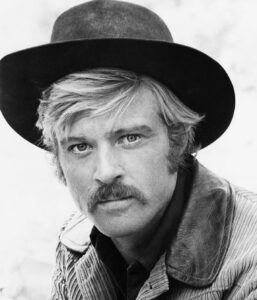
I was 12 when the movie hit the screens in 1976 and it all seemed so romantic to me: clandestine meetings with anonymous sources in dark and scary parking garages, Robert Redford clanking away on an old typewriter and the amazing Jason Robards just crushing the role of the charismatic, wise and fearless editor Ben Bradlee.
I could see myself doing this, I thought.
But as cool as it all seemed, my aspirations to write for a newspaper ranked fourth in my boyhood mind: right after pitching for the Yankees, playing centerfield for the Mets and winning Wimbledon.
Ahhh…youth. The endless possibilities of possibilities.
Needless to say, I never did pitch in the majors and the closest I came to winning Wimbledon was finishing runner up in a junior tournament at the Stony Brook Swim & Racquet Club –losing the match after a foot fault was called at the worst possible moment —but that’s a story for another day.
Today my mind is on journalism and the nobility of that profession.
We went to see The Post which has lots of Oscar buzz and star power with Meryl Streep and Tom Hanks anchoring a stellar cast.
“It’s a must see for journalists,” to quote my friend Marisa Herman, herself an excellent young reporter.
It’s also a must see for all those who value the important role the press plays in a Democracy.
Quite simply, there is no Democracy without a free press.
A press free to report, opine, investigate and publish without fear of government censor or seizure.
Far from being the enemy of the people, a free press is a guarantor of our American ideals. As Washington Post editor Ben Bradlee says in the movie: who else will hold em accountable if we don’t?
The Post is a fascinating look at the decision by Katharine Graham to publish The Pentagon Papers despite threats from the Nixon administration.
Among the myriad of issues is whether the sanctity of the First Amendment trumps the power of the presidency to keep certain sensitive and potentially embarrassing items a secret.
The Supreme Court said it does and so the Washington Post and the New York Times prevailed in their court battle over the Pentagon Papers.
Thank goodness, they did.
It’s a feel good movie that chronicles an era and has some eerie relevance to our current times.
The Graham family were powerful Washington players and were said to play strong behind the scene roles in D.C. politics. The legendary Bradlee was close friends with JFK and Jackie and Katherine Graham was close with Vietnam era Secretary of Defense Robert MacNamara. It didn’t stop her from giving the go ahead to publish the Pentagon Papers which would lay bare the deception promulgated by several administrations regarding the Vietnam War.
As someone who has worked as a reporter, editor and publisher I can relate –on a small level– to having to report on people you know and like.
More than once during my career as a reporter I was asked to pull punches, hold off on stories and look the other way.
As Bradlee notes in the movie, people can be friends or sources but not both.
The Post is a great primer for any young person considering a career in journalism. It’s also a stirring reminder of how important a role the press plays in keeping citizens of a Democracy informed.
I’ve been in the unique position of having covered elected officials as a reporter and being covered as an elected official. One of my greatest frustrations of being on the other side of the notebook was I felt many local reporters were missing the larger stories happening in the community. I wanted more coverage, not less because I felt so much was being missed. Covering government meetings often devolves into “he said, she said” stories. Where journalists can shine is to provide the information or objective facts that can tell you whether he or she is telling the truth. Sadly, that’s often missed. But great local journalism does exist and its immensely important. I often wonder if our dismal turnout for local elections is in part caused by citizens not knowing what’s really going on and therefore missing out on how important it is to know and to cast a ballot.
If citizens saw a movie like The Post, they may be inspired to read, get involved and engage in the issues.
The Post is great storytelling. Essential history. A movie that reminds you of why a free press keeps us free.