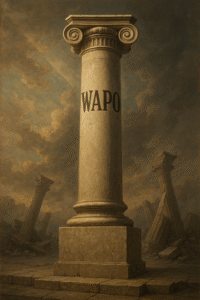
I grew up believing in newspapers.
They were institutions — imperfect, sometimes infuriating, but essential. Sacred, even. You didn’t mess with them. You didn’t hollow them out. You didn’t treat them like a line item on a spreadsheet owned by a man worth $240 billion.
Recently, the Washington Post laid off roughly a third of its workforce. More than 300 people. The sports section — shuttered. The books desk — gone. The flagship podcast Post Reports — suspended. The entire Middle East bureau was eliminated. The Ukraine bureau chief was let go. A correspondent learned she’d lost her job while reporting from a war zone.
Let that sink in. A reporter covering a war — an actual war — got an email telling her she was done.
This is the Washington Post. The home of Ben Bradlee, who stared down a president and published the Pentagon Papers. The home of Bob Woodward and Carl Bernstein, who brought down a corrupt administration with shoe-leather reporting and the stubborn belief that the truth matters more than power. The paper whose motto — “Democracy Dies in Darkness” — used to mean something.
Now it reads like a warning label they ignored.
I spent more than 20 years in journalism. I know what a newsroom feels like when it’s humming — the ringing phones, the arguments over headlines, the adrenaline of a story breaking wide open. I also know what it feels like when the cuts come. The silence that follows. The empty desks. The people who gave everything to the craft walking out with a box and a severance check.
It never stops hurting. And it never stops mattering.
What’s happening at the Post isn’t just about one newspaper. It’s about what we’ve decided journalism is worth in this country. The answer, apparently, is not much — not when the owner has a yacht worth $500 million, a wedding that cost $50 million, and a company that just invested $75 million in a movie about the First Lady.
But he can’t find the resources to keep reporters in the Middle East.
Jeff Bezos bought the Washington Post in 2013 for $250 million. At the time, he was hailed as a savior. Here was a tech visionary who understood that great journalism needed investment, not austerity. He poured money in. The newsroom grew by 85 percent. The Post became a digital powerhouse, competitive with the New York Times for the first time in a generation.
And then something shifted.
In late 2024, Bezos killed the editorial board’s planned endorsement of Kamala Harris — an unprecedented intervention that sent 250,000 subscribers running for the exits. Former executive editor Marty Baron called it “cowardice, with democracy as its casualty.” Woodward and Bernstein issued a joint statement calling it “surprising and disappointing.” Columnists resigned. Editorial board members stepped down.
The damage was self-inflicted and staggering. And instead of course-correcting, Bezos doubled down. He installed a management team that reshaped the opinion section around libertarian ideals, drove away more talent, and alienated the very readers who had sustained the paper. He hired a publisher, Will Lewis, who didn’t even show up for the call announcing the layoffs.
Sally Quinn, widow of Ben Bradlee, put it plainly: “It just seems heartbreaking that he (Bezos) doesn’t feel the paper is important enough to bankroll.”
Meanwhile, over at the New York Times, they’re thriving — 12.8 million subscribers and growing, heading toward 15 million by 2027. Warren Buffett’s Berkshire Hathaway just announced a large stock purchase.
The Wall Street Journal is doing fine. The difference isn’t the market. It’s leadership. It’s commitment. It’s the willingness to invest in what a great newspaper can be rather than strip-mining it for what it used to be.
The Post’s reporter Emmanuel Felton, who covered race and ethnicity, said it best after he was let go: “This wasn’t a financial decision. It was an ideological one.”
And Caroline O’Donovan, the reporter who covered Amazon — Jeff Bezos’s Amazon — was among those cut. You can’t make this stuff up. Actually, you can. It would make a hell of a third act in a play about a billionaire who bought a newspaper and slowly strangled it.
Here’s what bothers me most. When Bezos bought the Post, he talked about civic responsibility. He invoked Katharine Graham. He said the paper would follow important stories “no matter the cost.” Those were beautiful words. They were also, it turns out, just words.
A man with $240 billion in personal wealth chose to gut one of the most important journalistic institutions in American history rather than sustain it. He chose to protect his relationship with political power rather than hold it accountable. He chose his business interests over the public interest.
That’s not stewardship. That’s abandonment.
The Post Guild said it right: “A newsroom cannot be hollowed out without consequences for its credibility, its reach, and its future.”
Former executive editor Marcus Brauchli added: “The Post occupies a singular place in American journalism. It needs visionary and independent stewardship that is equal to its journalism, worthy of its promise, and necessary to meet this important moment in history.”
I think about the reporters who were in the building that day. The ones who stayed up the night before finishing their stories, knowing they might be locked out of the system in the morning. The ones who got the email with the subject line that told them their role had been eliminated.
Those journalists didn’t fail. Their owner did. I know what that’s like. I stood in a newsroom when layoffs were announced my heart racing and aching at the same time. And I’ve made those announcements myself when ownership failed to figure out a sustainable path. Sometimes business goes that way. It’s awful and it’s painful, but the papers I worked for and eventually led didn’t have near the financial and technological resources of Mr. Bezos.
Jeff Bezos will be fine. He’ll fly his rockets and sail his yacht and throw lavish parties. His legacy, however, is another matter. When the history of American journalism is written, there will be a chapter about the billionaire who had the resources to save the Washington Post and chose not to. Who had the chance to be Katharine Graham and became something far less.
That chapter will not be kind.
For those of us who love journalism — who believe that a free press is not a luxury but a necessity — this is a gut punch. But it’s also a call to action. Support the reporters. Subscribe to the outlets that are still doing the work. Demand better from the people who own the institutions we depend on.
Democracy doesn’t just die in darkness. It dies in indifference. It dies when the people with the power to keep the lights on decide it’s not worth the trouble.
Don’t let them make that decision for you.