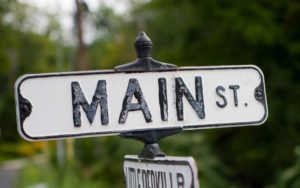
Is Amazon gunning for Main Street?
So I’ve been doing a lot of thinking lately about Amazon.com.
The e-commerce giant has been all over the news lately finally naming two winners to share the spoils of its H2 Headquarters quest and dominating Black Friday and Cyber Monday sales.
I’ve long wondered about the pros and cons of incentives but my reading about the deal and Amazon’s business model led me to wonder and worry.
What are we doing?
Is Amazon growing too big for our own good?
Has Jeff Bezos created a monster that taxpayers in Virginia and New York are subsidizing?
What does this mean for Main Street?
Then I read an interview with Starwood Group CEO Barry Sternlicht on Bisnow Media and my gravest concerns were verified.
Here’s a quote that ought to make us think.
“I was super disappointed in the cities they chose. Neither city needed them. And the fact that New York is in an opportunity zone and they got $5.5B of credits for the $5B of investment. I’m not a fan of the gifts. I mean, really? Amazon, a $1 trillion company doesn’t have the resources to build a plant? They need inducements? A $1 trillion company. And by the way, Amazon’s job these days is to put most everyone else out of business. So you’re facilitating that. Mom and dad can’t get a $5B tax break to expand their dry cleaners.
If you’re Amazon and you want to be a responsible corporate citizen just say, ‘No. We can do this on our own. We’re big boys. We’re worth $1 trillion. We’ll build these plants on our own.’ Why not go to a city like Atlanta or Miami, and why pick some place that doesn’t really need you? And those are congested cities, particularly New York, and the fact that it’s in an opportunity zone so they’ll never pay taxes on the building and land. I find it abhorrent. I think it’s just awful. It’s like a free headquarters. Why doesn’t somebody give me a free headquarters?”
Here’s another one that ought to give you pause or maybe hives.
“Amazon was fine when they helped little businesses survive, now they’re actually going after little businesses. And that’s not healthy for this country. You’re creating a monster. Now you’re funding the monster to destroy mom and dad’s businesses. That ain’t a good deal.”
The coup d’grace was Sternlicht’s next set of sentences:
“The endgame for Amazon is to wipe out the main streets of America. Maybe if the consumer is so busy he’s OK with that. But I can assure you they don’t know the consequences of what they’re doing. Those commercial businesses along main street pay the real estate taxes that fund schools and if they go away, and most assuredly they are going away, then taxes on individual homes will have to go up to pay for the support system.
I don’t think the average person spends a lot of time thinking about that. It’s really convenient to have them deliver a bicycle pump to your house that costs $20 for free in an hour. By the way, that’s predatory pricing. In the industrial commodity complex if you sell aluminum below the cost of consumption of aluminum, it’s called dumping and it’s illegal. They’ve been allowed to get away with that forever. They’ve lost more money in shipping than they made in the margins on the goods that they were selling. That’s predatory pricing and they were never called out on it. In my view, what they’re doing is illegal, and it crushed mom and dad. How can you compete with that?
The endgame where the consumer will get really crushed is when my little store that I used to go to buy my pump is out of business and Amazon will charge me $80 for a pump and $200 to have it delivered. The government put restrictions on the sale of vaping for teens. That’s the government looking to the future and saying it’s not good for teenagers. The government could look to the future and say, ‘You’re going to destroy America as we know it today, and we can’t let that happen.’”
Wow….
In the interest of full disclosure, I buy frequently from Amazon. Like everyone else, I enjoy the convenience, the vast selection and the ability to shop prices. Companies that I work with do lots of business on the Amazon platform and it has added to their bottom lines and our ability to access consumers throughout America.
But I do worry about what all of this is doing to Main Street. In Delray, we have an interesting dynamic, high real estate values which lead to high rents and a shifting landscape which makes it hard for independent retailers to survive. These conditions lead to vacancy, which isn’t good for a Main Street.
But I also don’t think it makes any sense to long for the good old days or wish that technology is going to retreat. It’s not.
Retail—at least as we knew it– is over or at the very least highly challenged.
Sure there will be stores, but successful retailers will have to carve out a very distinct niche, learn to be “experiential,” employ a digital strategy and or exist in high traffic areas. It’s possible to succeed, just not easy or obvious anymore. And frankly—as the son of a retailer—it never was easy.
Still, while it seems counterproductive to wish away the likes of Amazon, there are some big issues that we need to talk about as a society.
If retail fails or shrinks considerably (and that’s what’s happening), it will have an impact on sales and property taxes which fuel local government.
Real estate on and off Main Street will have to be rethought and reinvented.
There’s peril and opportunity in change, the challenge for leaders and communities is to make you maximize opportunity and hedge against peril.
P.S. the next article I read on Bisnow was an interview with Jorge Perez, CEO of Related Companies. It was on sea level rise and included this quote: “Sea level rise is something that is going to hit us all.”
Yes it is…and that’s a thought for another day. We sure do live in interesting times.
