With Rights Come Obligations

Someone I admire sent me a note over the July 4th weekend.

He knows I struggle with the division I see in our country and right here in our own community.

I suspect I am not alone in that struggle. It seems like every week there’s another flare up that drives us further apart. This week, sadly, is no exception.

So my friend referred me to a link that discussed a concept called “civil obligations.”
We often talk about civil rights and they are important, but I am beginning to think that without obligations and responsibilities, rights are just not enough to build a strong and enduring society or community.

I’m happy that my friend turned me on to the writing of Sister Simone Campbell, known as “the nun on the bus.”

Sister Simone is the executive director of NETWORK, an organization that advocates for socially just federal policies.

Sister Simone is a strong believer in civil rights. She notes that the civil rights movement was forged by a community, but the advances were focused on individual rights. An unintended consequence is that some people feel threatened by those rights —as if there are not enough rights to go around. So they created their own movement. As a result, we have an endless cycle of friction.

Here’s how Sister Simone describes the dynamic:

“A democracy cannot survive if various groups and individuals only pull away in different directions. Such separation will not guarantee that all are allowed the opportunity for ‘life, liberty, and the pursuit of happiness.’ All people must be recognized for their inherent dignity and gifts regardless of the color of their skin, their religious beliefs, or their place of origin. And all these gifts need to be shared in order to build up the whole. So I have begun to wonder if the new task of the first half of the twenty-first century should be a commitment to civil obligations as a balance to the focus on civil rights.”

I think she’s on to something.

So what are civil obligations?

Let’s let Sister Simone explain.

“Civil obligations call each of us to participate out of a concern and commitment for the whole. Civil obligations call us to vote, to inform ourselves about the issues of the day, to engage in serious conversation about our nation’s future and learn to listen to various perspectives. To live our civil obligations means that everyone needs to be involved and that there needs to be room for everyone to exercise this involvement. This is the other side of civil rights. We all need our civil rights so that we can all exercise our civil obligations.”

She continues: “The mandate to exercise our civil obligations means that we can’t be bystanders who scoff at the process of politics while taking no responsibility. We all need to be involved. Civil obligations mean that we must hold our elected officials accountable for their actions, and we must advocate for those who are struggling to exercise their obligations. It is an unpatriotic lie that we as a nation are based in individualism. The Constitution underscores the fact that we are rooted and raised in a communal society and that we each have a responsibility to build up the whole. The Preamble to the Constitution could not be any clearer: “We the People” are called to “form a more perfect Union.”

Isn’t that cool? Doesn’t it make sense?

I don’t think being armchair citizens, tweeting and posting gripes is enough. We need active participation. We need voters, candidates, volunteers, mentors, servant-leaders and philanthropists.

The City of Santa Monica measures happiness and I always thought that was interesting. We seem to measure property values and not much else.

We ought to take our civic temperature and judge not only whether stakeholders are happy but whether they are emotionally invested here.

Do they know what Old School Square is all about? Do they use the library? Do they vote? Would they volunteer to serve in some sort of capacity? Are they interested in schools, helping our police department or mentoring young people? The list of ways to engage is endless.

In my experience, while some people will just show up to  work in the community, it helps immensely if we  ask them to get involved and to create a culture of participation.

But whether your community values participation or employs a top down model of governance, we the people have an obligation as well.

An obligation to be informed; to seek facts and be independent thinkers. An obligation to vote—so few of us do— especially in local elections.

Rights are accompanied by obligations. We have to exercise those rights, protect them and work on behalf of the whole.

With America divided and so much friction in our local communities, the call to embrace civil obligations is more important than ever.
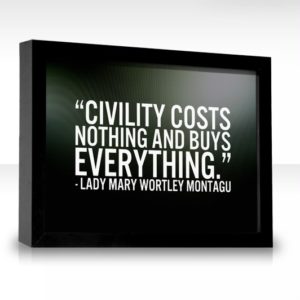



The Importance of Civility


“It is the willingness to listen. The thing I fear most is the absence of civility; I don’t fear the argument.” –Leon Botstein, President Bard College.

I saw that quote a few weeks back while on a business trip and it resonated with me because I think Mr. Botstein nailed so much of what’s wrong today.

I don’t think we are willing to listen anymore—certainly not to anyone that we disagree with. We seem to want to assign bad motives to those on the other side of an issue and make a beeline toward the yelling.

Like the President of Bard College, I fear the absence of civility because if we aren’t civil what’s left other than a spiral to violence?

We are at a precipice in America. And we best be careful. Because when you dance on a cliff you might find yourself slipping into an abyss that’s not so easy to climb out from.

So as I wandered the hallways of the Las Vegas Convention Center marveling at the elaborate exhibits at the International Council of Shopping Centers—the new retailers, the cutting edge technologies, the new and wildly creative food and beverage concepts and the dizzying array of deal making—I couldn’t help but feel both excited and worried.

On so many levels, the future looks bright.

The bar is being raised everywhere you look in business and technology.

Is it all good?

No.

We went to a local Walmart when I came home and we watched everyone struggle to scan their own items and I thought “you know I don’t work here, this isn’t efficient and where the heck is the cashier?”

But a lot is good….the plant based burgers that taste like the real thing, the marvelous places design is taking us, the amount of computing power we walk around with when we carry our cell phones and we always carry our phones don’t we?

But the worrisome part is the human part. How we relate to each other.

When we were in Vegas my hometown went to war—at least on Facebook– over a proposal by iPic to add a rooftop restaurant/bar to their new location in downtown Delray.

I can argue both sides of the issue and I see where both sides have some good points. So a good debate/argument would have been fine. One where we listen, one where we decide what’s best for Delray. But on social media that’s not how things play out.

While there were some good arguments articulated, there were a raft of disturbing comments as well.

In the spirit of Jimmy Kimmel’s “mean tweets” segment— in which celebrities read aloud comments made by online trolls—

I’ll share a few. With some commentary of course.

“It’s all about developers BUYING Commissioners!”

 (Comment: there’s no evidence of bribery and if there please alert the authorities.  iPic is not a developer and this is a tired argument used whenever someone proposes a project. I especially love it when someone who lives in a project that was protested when it was proposed makes this argument. I can’t help but think, if the commissioners of their day had listened, you might not live here.)

“I pic (sic) can go to hell in a handbag. They can’t cry over spilled milk. Bieng (sic) underhanded got them no where, and good! (Comment: the logic is almost bad as the syntax).

“So glad I left Delray….when the Yankees took over…”

(Comment: I’ve seen this tired trope a few hundred times, sometimes New Yorkers are used instead of Yanks, but as a New Yorker I get the not so veiled message: this place was Eden before the New Yorkers came here and ruined it. Not only is that a horribly flawed argument, it’s often made by people who are in business as if Yankees don’t buy homes, cars, furniture, meals, financial products etc. There’s one realtor I will never do business with because he just loves to insult New Yorkers. Now that I know what he thinks of me, I figure there are many other good realtors who may appreciate my business and referrals. Is that petty? Maybe. But if I was his broker, he’d be out the door in a New York minute).

I can go on and honestly this last spasm of nasty wasn’t as bad as some others that I have seen. It’s why I use Facebook to share pictures of dogs and my blog—while avoiding the various groups and pages that feed the divide rather than foster debate. For the record, I was texted “screen shots” of the quotes I shared until I begged the sender to stop. I got the drift.

Bottom line: there has got to be a better way.
Because I don’t think the current way is really working here or elsewhere We don’t seem happy as a nation, we don’t seem to be solving problems (as a society) and we don’t seem to be united on much these days.

As a former elected official, I wrestled with some similar challenges. But it seems social media has taken it to a new level of mean.

The commission’s I served on tried to find ways to connect and to foster respectful debate. Sometimes I think we did and sometimes we fell short.

We urged the chamber of commerce to get involved, we tried to create a safe environment at city meetings, charrettes, town halls etc. and we tried to introduce neighbors to each other through “neighborhood dinners.”

Was everybody happy?
Not on your life. (And I have the emails to prove it).

But we tried, and we also understood that you can’t make everyone happy. You have to make decisions and that means some people will walk away fuming. It goes with the territory.

But most of us on the dais, endeavored to raise the level of debate, to keep it fact-based and to do what we felt was best for the long term good of the community. Ultimately, it’s up to the voters and history to decide whether leaders at any level succeed.

But ultimately, it is about civility. The ability to work with our fellow citizens is essential to a healthy and sustainable democracy. Community begins to fall apart when civility crumbles.

Let’s not fear the argument. Let’s fear the absence of civility.


Alone Again, Naturally?

There’s a loneliness epidemic in America.

That’s the conclusion made by Arthur C. Brooks, the president of the American Enterprise Institute, citing a recent study by health insurer Cigna which says most Americans suffer from strong feelings of loneliness and a lack of significance in their relationships.

Wow.

Stop and think about that. Here’s another showstopper from the survey:

“Nearly half say they sometimes or always feel alone or “left out.” Thirteen percent of Americans say that zero people know them well. The survey, which charts social isolation using a common measure known as the U.C.L.A. Loneliness Scale, shows that loneliness is worse in each successive generation.”

At first, the survey feels counterintuitive. In the age of social media, where we are able to access “friends” 24/7 regardless of location via Facebook, Instagram and other platforms it would seem we would feel more connected than ever.

But 2018 was the year in which we finally stopped long enough to truly consider social media’s impact on our lives and society. Maybe instead of making us closer, it is driving wedges based on our political beliefs. Maybe instead of deepening friendships it has made them hollow—as we share only the best part of our lives in an endless search for “likes” and “retweets.”

I suspect I’m like most people in that I have mixed feelings about social media. I enjoy being able to stay in touch– even nominally– with old friends, classmates, teachers, co-workers and relatives who live far away. But I’ve seen cyber bullying, real “fake news” and manipulation as well. I’ve seen the worst aspects of social media take a toll on relationships and actually prevent people from speaking their minds or participating in civic life for fear of being trolled.

So when you look at the full spectrum, you can see where loneliness can take root.

And it’s not just social media—it’s media in general. Talk radio, cable TV and some print publications peddle an “us” versus “them” narrative which serves to put us in silos where we only interact with people who agree with us.

I find myself avoiding conversations unless I know where people are relative to politics. It seems we are locked into our own set of facts, which ought to alarm everyone because it’s hard to find compromise or consensus if you can’t even agree on objective facts.

All of this leads to a sense of isolation and I guess loneliness. I have my tribe, you have yours and there’s a sense that we share a house that’s divided and we all know (or do we?) what Lincoln said about a house divided.

Brooks and others who have written about this subject also lament the changing nature of work—where the “gig” economy replaces the camaraderie of the office where relationships evolve over years of working side by side. It’s hard to build friendships when you’re driving an Uber or hopping from gig to gig.

Too many Americans don’t feel “rooted” in community these days, according to the research.

Senator Ben Sasse of Nebraska recently wrote a book about this subject. In “Them: Why We Hate Each Other — and How to Heal,” Senator Sasse writes about “thick” communities, places that where people have real histories and deep relationships with each other. He describes the feeling as a “hometown gym on a Friday night.”

I’ve heard variations of that sentiment over the years regarding Delray. People would say they go downtown and no longer see anyone they know.

I had a colleague on the city commission years ago who used to say that the difference between Delray and Boca was simple: if you asked someone from Delray where they lived they’d answer “Delray.” But if you asked someone from Boca, they’d give their neighborhood such as “Woodfield” or “The Polo Club.”
I don’t know that to be true or not, but it’s an interesting thought.

When your downtown once lacked vibrancy, you actually take pride when you visit and see a crowd of strangers. Hey, at least there’s a crowd. But now I can see what people mean when they long for the days of going downtown and bumping into friends and neighbors.

I am a firm believer in community building—it’s important. It’s vital and if it is missing you end up a lonely place.

In the 80s, 90s and early 2000s, Delray Beach became an All America City and a different place because the number one mission of civic leaders was to build community.

There was an active effort to help neighborhoods form associations. There was an active effort to involve youth in activities such as the Youth Council. There was a huge amount of resources devoted to “community policing”, visioning, recruiting people for advisory boards and creating a large volunteer pool for our police and fire departments, non-profits, schools etc. There were town hall meetings, charrettes and roundtable discussions.

I think it made a difference.

I think it built friendships and civic capacity. It may have eased a sense of loneliness and isolation too.

Special events—which became so controversial and maligned—also played a role. It seems like everyone went to First Night on New Year’s Eve and Art and Jazz on the Avenue was something you just had to attend because as you strolled the avenue you’d see a lot of people you knew and cared about.

Today, there are some really good groups trying to build community: Wise Tribe, Community Greening, Old School Square, the Historical Society, the Beach Property Owners Association to name just a few.

In his New York Times op-ed, Brooks reaches out to Senator Sasse because he’s moving to a new state and he fears being isolated and rootless. Here’s the advice he gets. It something I hope we all heed.

“(Sasse) told me I had it all wrong — that moving back home and going to the gym on Friday aren’t actually the point; rather, the trick is “learning how to intentionally invest in the places where we actually live.” In other words, being a member of a community isn’t about whether I have a Fremont (Sasse’s hometown). It isn’t about how I feel about any place I have lived, nor about my fear of isolation in a new city. It is about the neighbor I choose to be in the community I wind up calling my home.


And there lies the challenge to each of us in a country suffering from loneliness and ripped apart by political opportunists seeking to capitalize on that isolation. Each of us can be happier, and America will start to heal, when we become the kind neighbors and generous friends we wish we had.”


Thanksgiving

“Gratitude is the healthiest of all human emotions. The more you express gratitude for what you have, the more likely you will have even more to express gratitude for.” – Zig Ziglar
It’s Thanksgiving week and we are grateful.
Yes, the news can be depressing.
Mass shootings—307 in 311 days, fractured politics, wildfires, hurricanes and starving people in Yemen are very real and searingly painful and yet…
And yet, there’s so much beauty in our world if only we would slow down just a tad, look up from our devices and soak it all in.
There’s great music, beautiful skies, a wondrous ocean and incredible art all around us.
There’s good people too.
Lot of really good people.
Right here in good old Delray Beach and Boca Raton.
I’m thankful for them all.
The volunteers, the dedicated teachers, the amazing men and women who serve in our police departments and fire service, the dedicated health care workers who are there for us when we need them most. And the list goes on and on.
On this Thanksgiving I want to say thanks to friends who are always there, family that gives me a reason for being, work that excites me, pets that fill my heart and a wife that patiently listens to my stories, feeble attempts at humor and occasional tales of woe.
So yes the news affects us all.
Important stuff is happening on so many levels.
So stay engaged, speak out, vote, protest if you feel like it and advocate for what you believe in. Never let anyone tell you your voice doesn’t matter or even worse: that you should keep your thoughts and ideas to yourself. Share. Engage. Try and help others—there are so many needy in our world and right here at home.
But give thanks too—if you can. It makes a huge difference.
Have a wonderful Thanksgiving.
Thanks for reading and sharing your thoughts with me. See you next week in this space.

Homeward Bound

Beautiful Port Jefferson, N.Y.

This is a hyperlocal blog focused primarily on Delray Beach and Boca Raton.
But we also focus on cities, leadership, entrepreneurship and the general notion of community; what it means and how to build it.

So in the spirit of exploration I wanted to share with you some thoughts after a recent and all too brief trip “home” to the Port Jefferson/Setauket/Stony Brook area.
It’s where I grew up on eastern Long Island after being born and spending a few years in Queens.

It’s a beautiful area, magical in so many ways.

The older areas are truly historic with buildings dating to the late 1690s and early 1700s.
The area played a key role in the Revolutionary War with George Washington’s Setauket spies doing important work to defeat the British. Those days were recently depicted in a TV series and information about the spy ring is written on plaques and available on apps that give an oral history of the area.

We never lived in the historic parts of these towns, although we appreciated the older homes, wooded environments and colonial architecture.

My family and most of my friends lived in Levitt Homes, tract housing developed by the builder who invented suburbia after World War II.

Today, those homes are 50 years old plus and when I drove to see  a few of our old house (we moved around a lot) I could see the age on what was once so new. I enjoyed seeing the mature trees and for the most part the Levitt “sections” –as they were called— have held up well.

They are lovely in their own way and each street is filled with memories of community back when neighbors knew each other and when kids played outside until dark.

It was a magical time and we lived in a magical place. And as I shared with a best friend who grew up there with me, I’m grateful for the time spent here and saddened by the time that has passed.
I’m not sure when I will come back to Stony Brook. But I’m pretty sure that I will.

I feel very connected to the place.

It is and will always be home. The place where I went to school, where I lived with my parents and sister, where my grandparents (long gone but never forgotten) visited and where I met the best friends I’ve ever had and we experienced life’s adventures for the first time.

School days and favorite teachers and first crushes.
Parties and bar mitzvahs.
Little League, pick up basketball, stickball and football.
First cars, first loves, first everything.
Then, one day it ends.

And you go off—as you should– to explore new places, new experiences and new people.
But you never completely leave home and the experiences and the people that shaped you.

These are the people who support you, challenge you, push you and pick you up when you stumble and fall—as we all do.
I felt compelled to come home when I turned 40 and wanted to show a new love where it was that I came from. I thought if she saw the places that accompanied the stories and the personal history that we would grow closer and I think we did. I was also anxious to visit her hometown, Clairton, PA., a hardscrabble kind of place that explains a lot about who she became.

Fourteen years later, almost to the day, I felt compelled to return to my hometown.
I’m not sure why. Maybe its just important to touch —albeit briefly—your roots.
Your roots are what center and ground you.

I guess I needed a dose of home.

The Perils of Bickering

I subscribe to Axios.com which is serving as my morning news fix because my newspaper carrier can’t seem to deliver before I leave for work these days. (Sigh)
Axios is a compilation of well written news “bites” and analysis that makes you feel somewhat “in the know.”

Last week, there was an item that caught my eye and made me think. And worry.
The writer opined that the era of American economic and technological dominance was coming to an end and that China was going to surpass the USA within a decade.

Whoa!
Why?

Because China has a vision to dominate trade and technology and to become the world’s indispensable nation.
But beyond having a vision, China is executing by making investments in infrastructure, artificial intelligence and robotics with a stated goal of dominance.

Of course, China is a one party dictatorship with a President who just made himself leader for life. What Xi says goes. Period.
It doesn’t exactly work that way in the United States. Good thing too.

But it does make one wonder how we stave off competition from a nation as large, as capable and as determined as China.
It also makes you wonder when the last time we had a national vision that went beyond the next election.

It wasn’t always this way.

The Space Race, World War II and the war on terror are just a few examples of near universal national resolve.
It seems like everything else has been a struggle: civil rights, women’s rights, gay rights, health care, immigration, gun safety etc., have been battles.

There is nothing wrong with struggling for what you believe in. In fact, it probably makes you more appreciative when you achieve your goal. Also, Democracy is inherently messy and loud. But if it is to remain viable and competitive it needs to lead to something. The process (struggle) should be Democratic, but there needs to be outcomes too–or you risk losing your edge as a nation. Today, we have too many problems left unsolved by national “leaders” focused solely on beating their enemies, getting re-elected, rewarding their friends and erasing the other team’s work. Partisanship reigns over patriotism. It’s not just sad, it’s tragic and fatal if not addressed.

This blog is a champion of local solutions (localism) but there are some things that only a competent and effective federal government can accomplish: a national defense for instance, immigration policy, rebuilding our nation’s infrastructure.

But…
These days we bicker. These days we dawdle.
All the while, the competition plans and executes.

Still, on this corner of the web, we focus on cities and hyper local topics and so here’s where there are parallels.
The cities that have visions; the cities that execute win.
The cities that bicker and dawdle miss out.
It’s that simple.
Really. It is that simple.
So make decisions.
Take risks.
Be civic entrepreneurs.
Invest.
Re-invest.
Reach out and involve the whole community.
Listen.
Learn.
Question.
Experiment.
Make the good stuff easy.
Turn down the bad stuff.
But don’t bicker.
Don’t dawdle.
We live in a competitive landscape and we can’t afford our communities to major in the minor.
Progress and prosperity flows to cities which create a culture that celebrate those who aspire.
Progress and prosperity will miss places that bicker and dawdle.

As Bruce Springsteen sings about Atlantic City: “Down here it’s just winners and losers and don’t get caught on the wrong side of that line.”


Land Of Hope And Dreams

Bruce Springsteen and his wife Patti Scialfa after a show at the Walter Kerr Theatre on Broadway.

I can’t let my Springsteen on Broadway experience pass without sharing some takeaways with you.
First, the show is remarkable.
The power. The passion. The sharing. The stories. The humor. The descriptions of life and landscapes are masterful.
And the music…well the music is sublime.

With the exception of two songs performed with his wife Patti Scialfa, the show is all Bruce. Just a piano and an acoustic guitar.
Bruce’s songwriting prowess often overshadows  his guitar playing but on the night we saw him we marveled at how his acoustic filled the Walter Kerr Theatre.

It’s a rich sound. Powerful. And it allowed him to change arrangements on songs giving them new texture and meaning.

The stories and themes that accompanied the music were a big part of the night. Bruce covered a lot of ground as he told his life story weaving in themes ranging from love and trust to parenthood and aging.
As he ages..as we all age…there’s a poignancy that comes with a Springsteen performance.
We know it won’t last forever.

We know we won’t last forever.

And so we appreciate the moments more, we savor the experiences, the feelings, the closeness and the love we have for not only the music (which is truly magnificent) but for the community this man and the E Street Band have created since 1973.

Last week, I wrote that Springsteen was about hope. And he is. But he’s also about community.
He’s worked hard to create it. He’s worked hard to scale it and he’s worked hard to deepen it and keep it going. There’s lessons to be learned from how he’s built and sustained a large tribe. There’s also lessons in why it’s meaningful to belong to…something.

Bruce closed the show with a story about returning to his hometown of Freehold, N.J. recently only to find a beloved childhood tree had been removed.
He was angry and saddened by the loss. But he also noticed that the roots system was still in place.

While the physical tree was gone, he felt the energy of the tree was very much intact.

He concluded with a prayer and a wish that the community he had built, the music he had created, would hopefully live on. Much like the roots system of the tree.
As I reflect on the show, I realized that I just loved this message.

In many ways we all try to build communities, families, businesses, works of art, relationships and more. It’s imperfect, it’s lifelong and sometimes we succeed and sometimes we fail. But we hope it adds up to something. We hope it means something. I’m sure it does.

We also hope it lasts, even if we know that we won’t.

Bruce talked about the magic of his legendary E Street. How when you experience magic–one plus one somehow equals three. How true.

And so I thought back on my life and my friends. How when it clicks you can move mountains, make lasting memories with good friends, create a family, start entrepreneurial ventures, grow organizations and touch lives.
That’s what it’s all about: striving for magic, working hard to make it happen, taking risks and enjoying the journey knowing that there’s pain, loss and setbacks but love, joy and passion too.

In the song “Land of Hope and Dreams”  Bruce sings of a mythical train where there is room for everyone. You don’t need a ticket, you just climb aboard. The destination is a land of hope and dreams, a place where we all find love, acceptance and freedom.
Amen.

Threads

“If you don’t know why something is working when it is, you won’t know how to fix it when it breaks.” – Craig Groeschel


There’s a lot of writing about cities that refers to something called the  “civic fabric.”

Civic fabric refers to the framework/structure/material that make up communities.

The best leaders add to the fabric—they strengthen, invest in and tend to the framework that make places special.

The opposite of leadership is tearing at the fabric.

When you start to pull threads, you risk fraying the material and risking the structure.

For five years, in my opinion, we have torn viciously at the fabric—and as a result 30 plus years of municipal progress, civic pride and the marrow that makes our community special is at risk.

It doesn’t give me or others who feel the same way I do pleasure to write those sentences. And speaking truth to power certainly hasn’t been easy. Those who do pay a price…civic projects, causes, businesses, non-profits and friends have been hurt because they have not gone along to get along.

That’s OK.

It’s important to be able to look in the mirror and say you have stood up for your beliefs.

But the temptation is there to capitulate or just throw in the towel.

After all, you might be granted approvals for your projects or initiatives, instead of seeing them litigated, delayed and ridiculed—even if you have a contract (Matchpoint), won an RFP (iPic) or played by the city’s rules (Atlantic Crossing).

My advice: don’t.

Don’t give up.

Continue to stand up, speak your piece and move forward.

If your favorite candidate won the election last night, congratulations.

Local elections can be brutal affairs.

The arguments are personal because we see the combatants around town—we live in each other’s neighborhoods, go to the same stores and restaurants and know each other’s friends and supporters.

But if you won, the work is just beginning.

Serving in local elected office—or any elected office—is a privilege and an honor. As is winning an election. But all it means is that you have a chance to serve and an opportunity to make a difference.

You’re on first base, you still have to get home. And we hope you do, because if you succeed the community succeeds. We all win.

If you lost last night, it’s hard.

I’ve backed many candidates who have lost. It happens. I’ve backed a few winners too.

If you backed someone you believe in, take pride in that. Because something as precious as your hometown should not be about picking winners, it should be about backing someone you believe in.

I believe in Ryan Boylston and was pleased to see a talented young leader with ideas and aspirations for Delray win. Our newspaper endorsed Adam Frankel and he won over an impressive debut from Eric Camacho who I hope runs again. We are also pleased to see Bill Bathurst, a lifelong Delray resident, get elected unopposed. Bill is a very nice man with a lot of ideas and a tremendous passion for Delray.

Many—myself included– were disappointed to see Jim Chard lose, but we want to see Shelly Petrolia succeed as our next mayor because cities do better when mayors succeed.

For those who are disappointed, my advice is to play the long game and stick to your beliefs, because over time it pays off.

My hope is that the new mayor and commissioners are servant leaders who engage, listen, unite, compromise and learn on the job.

Because the fabric begins to fray when favorites are played and rules are ignored, bent, spindled and mutilated to reward friends or punish enemies.

The fabric tears when a city’s volunteers and staff feel put upon, disrespected and disparaged; when City Hall becomes a place you fear rather than a trusted partner.

We are a city in need of healing. That’s my opinion and that’s why I backed who I backed.

That doesn’t change regardless of outcome.

To those who don’t feel that we are in need of healing, you ought to talk to the volunteers in this town or the employees who often can’t afford to speak out so they either remain silent or vote with their feet and leave us for other cities.

That said, I vowed after this election to take a break from some of the local sites on social media regardless of the outcome.

While I’ve never participated in most of them, I did look at one in particular run by good people. But when I found myself arguing with someone I grew up, I decided that it was a sign to cease and desist.

It’s not the folks I’ve never (or barely met) that bother me—how can they because we don’t know each other?

It’s when the people you do know start buying into a narrative that you know in your bones is false, that you need to step away because it’s no good for anyone.

I’m beginning to believe that social media is tearing at the fabric of our community.

I want to revisit this idea of civic fabric, because when you start to pull threads you don’t know which one will trigger the collapse.

Is it losing the St. Patrick’s Day Parade after 50 years? Is it telling every craft brewery to look elsewhere?
Is it calling the CEO of a publicly traded company who wants to come here that he’s an “amateur?”

Is it referring to the founder of Old School Square as “that woman?” Or is it telling your police officers and firefighters that they are replaceable?

I’m not sure. But I know those are examples of pulling threads—ripping at the fabric.

I want to see leaders who lift us up. That’s their primary job, even when (maybe especially when) we see things differently.


The Power of Friendship

Let’s start the new year off on a positive note by talking about friendship.
As we made the rounds of holiday parties this season, we felt blessed by the people in our lives; enriched by the friendships that make life worth living.

These are the people who make the stresses of daily life melt away and renew your faith in humanity.
I’ve mentioned before that I have  several groups of friends who meet for breakfast, lunch and the occasional happy hour and dinner.
Some know each other. Some don’t.
But all of them have something in common: they tend to care about the world, they tend to be involved in the community and they tend to be smart with sharp senses of humor.
In short, good people.
Really good people.
The older I get, I find myself valuing my friends more and more.
I also find I have less tolerance for toxic people.
Over the holiday break, I listened to a  TED Talk by the director of a Harvard study on male happiness.
The study has tracked a group of men from childhood into their 90s. The cohort includes people from all walks of life, including a U.S. president (whom the speaker did not name).
The happiest and healthiest people were those who made and kept good friends and those who felt connected to a community.
Not only were they happier and healthier, but they handled adversity better including tolerance of physical pain.
It’s an interesting study and very validating.
As we launch into yet another election cycle with candidates slinging shots at each other, each other’s supporters and even the cities they seek to lead (Delray is too this, Boca is too that) it would be nice if we added some gratitude to the mix.
No, we are not perfect. But we sure have a lot to be proud of and a lot to be thankful for.

I plan to support the candidates who get this very fundamental idea. And those who seek to unite: not incite and divide.
I do look at who is supporting who because I tend to support the judgment of my friends—especially in a non partisan election. And thank goodness local government is non partisan. We’ve seen what hyper partisanship has done to our country. Let’s make sure that does not happen here.
Because not much gets done when it does. And whatever gets done gets undone when the other side takes over and in time they always do.

There’s a term we will hear more and more in the New Year. It’s called hyper localism. It refers to the notion that the action is devolving to the local level where collaboration is possible and where solutions are often achieved.

So give me candidates who want to grow the tent, not shut people off. Give me candidates who listen to their neighbors and work side by side with those who roll up their sleeves.
Give me people who understand that community is about relationships and friendship. Those who understand that a key role of a leader is to grow those relationships and that sense of community.

That’s what makes a happy community. And friends, a happy community is a productive community. An unhappy community gets stuck, defensive and lost.

As I made my way around the holiday parties I ran into contributors who served this town and gave so much of themselves to this place we call home.
The architect who has served on countless boards and saved historic homes. The former mayors who never went away and went on to lead non profits and community groups. The retired city staff who still care and formed a team that created a very vibrant place. The business leaders and young entrepreneurs who invest, build, create and dream. Really good people.
Special people.
The people who make us happy.

I’ll end with a tribute to old friends too. Those from childhood that I was also able to connect with over the break.
One visited from Wisconsin. We’ve known each other since we were five. It’s amazing. We connect instantly despite the distance. Despite the years. Despite the separate lives.
I also spoke to two old friends: one from Virginia and one who lives in California. We all grew up together, spent our summers chasing tennis balls and girls, listening to music and exploring New York City.
I miss these guys but the years melt away and the friendship renews with each call. It’s like we are meant to be lifelong friends, these connections made as kids follow us into middle age.
I hope you have friends and find friends in 2018. We will live longer, happier and healthier lives if we do. We will also create a happier, kinder and safer world.


A Place For Humanity Amidst Change

A vintage Sears catalog.

When I read the news, I look for patterns.

What’s bubbling just under the surface? What trends are starting to emerge? Are there clues out there to tell us where we are going next?
It’s fun to discern what might be happening and it’s also helpful in business to try and see where the world is heading.
What I’m seeing lately are a bunch of stories that indicate angst about technology and a push back against the dominance of our digital society. It seems that we are beginning to really worry about the addictive power of our smart phones, the amount of data tech companies like Facebook and Google have on us, the corrosive impact that social media can have on society and the ubiquitous reach of Amazon.
So this could get interesting.
One of the best trend spotters out there is marketing expert Seth Godin. Here’s what he wrote on Black Friday:
“The buying race is over. Amazon won. The shopping race, though, the struggle to create experiences that are worth paying for, that’s just beginning.”
Godin was lamenting the herd mentality whipped up by media to shop on the day after Thanksgiving.
But while he acknowledged Amazon’s dominance, he also sees opportunity for physical retailers in the “real world” to compete by offering experiences, service, design, fun and community.
We better hope so, because there are a lot of jobs, sales tax for local governments and consequences for Main streets and shopping centers if retailers don’t figure out a way to compete more effectively.
Another go to source for trends is “Redef”, an email newsletter that aggregates great stories from a wide variety of sources.
One recent piece came from the LA Times which talked about the comeback of catalogs. In an era of seemingly endless growth for online shopping, the humble mail order catalog is getting new life as merchants strive to battle email fatigue. 
While nobody is predicting the return of the Sears catalog (or the iconic retail chain) there seems to be growing anxiety over a purely cyber world. 
Don’t get me wrong. Facebook is great in moderation. Amazon is convenient and Netflix is wonderful.  
But it would be sad if we lost face the face interaction we get at a great retail store and the experience of seeing a movie with a group of people. 
While these and other industries are under assault by the threat of mobile and internet technology, there is some evidence that the “analog” world won’t go without a fight. 
The New York Times has experienced a surge in print subscriptions, vinyl records and cassettes are staging a comeback,  physical books and independent bookstores are enjoying a mini renaissance and there are retail districts around the country that are doing very well. 
While AirBnB is thriving, smart Hotel brands like Aloft, Hyatt Place, Canopy, and Ace are also proving to be enduring competitors. Boutique hotels such as Cranes Beach House, historic properties such as the Colony Hotel and larger but stylish options like the Seagate remain desirable for travelers of all ages. 
As for theaters, there seems to be room for Netflix and iPic, Hulu and Alamo Drafthouse. 
While Harvard sociologist Robert Putnam has reported on the phenomenon of people “Bowling Alone” which chronicled the struggles of civic groups and bowling leagues—there are a raft of new groups emerging:  One Million Cups, Creative Mornings, WiseTribe, Community Greening, Human Powered Delray and Better Delray carving out community. 
Locally, Rotary, Elks and Kiwanis remain vibrant and vital.
 
As for me, I don’t see technology retreating. I think we will see autonomous cars within the next 10 years, streaming services will grow and groceries will be delivered to our homes. But I do think that smart retailers who create experiences and relationships will thrive. Great restaurants will continue to draw crowds and while golf courses will continue to close— options like Top Golf (food, fun, night golfing) will fill the gap. 
I think the key will be placemaking. 
The cities that create vibrant, safe, walkable places will draw crowds and investment. Fred Kent, a part time Delray resident and founder of the Project for Public Spaces (www.pps.org), has reported on the “power of 10” –the need for communities to create at least 10 activities in order for places to thrive.  PPS is right. 
We will look up from our phones–if there’s something compelling and active to draw us in.
 We will want to gather for concerts at Old School Square and Mizner Park. We may want to take a class or two online but there will also be a desire to interact in person with other students and a desire to go to happy hour even though you can order beer, wine and spirits online. 
I think a backlash is brewing. We will bend technology just enough to allow us to remain human. 
At least that’s my hope.