Purpose Built

Many things have changed since the year 2000 in Delray Beach.

We’ve grown up, I suppose.

The town is big business these days. High real estate prices. Big-time commercial rents. Famous people spotted hanging out in our once sleepy downtown.

I’m not one of those who laments change. I understand that it’s inevitable and in many cases preferable. Stasis is not only impossible, it’s boring.
But I am nostalgic. Genuinely so. And I’ve learned that my favorite part of every endeavor is the climb.

I’ve been astonished at the success of Celsius, the energy drink my company’s founder discovered years ago and poured his heart into building. But as much as I’ve enjoyed seeing the company soar, I still recall the early lean years with fondness.
There were unsung heroes along the way — people who worked hard to build the brand. They were special. They were essential. Many didn’t make it to the mountaintop with the company, but their efforts were early bricks. They mattered.

I’ve also enjoyed watching Delray evolve over the nearly 40 years I’ve lived and worked here.
Those were my thoughts last week when I attended the Purpose Built Communities annual conference in Jacksonville. Purpose Built is a nonprofit network that brings proven tools to its members to help revitalize neighborhoods. The Carl Angus DeSantis Foundation is invested in Rise Coleman Park, a Purpose Built network member in West Palm Beach. We’ve also visited and been inspired by Lift Orlando, which has done a remarkable job lifting up a community holistically.

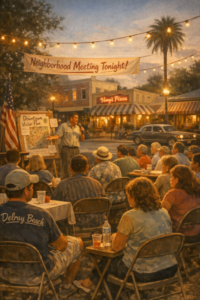
Sitting with network members from across America, I was reminded of my early days in Delray — a time of visioning, organizing, investing and dreaming. This is what I fell in love with. The civic pride. The aspiration. The neighborhood leaders who stepped forward and became something larger than themselves.

It was a time of high civic engagement. Charrettes — community visioning meetings — drew large, spirited crowds. Town hall meetings filled the Crest Theatre. Church gatherings to craft neighborhood plans attracted people of all ages. There were different ideas and opinions, but there was unity as well. Everyone was committing to lifting this city up. And they did.

When I ran for office in 2000, there were two animating issues — neighborhoods and the downtown. Neighborhood leaders were concerned about crime and appearance; they were asking for more information and hungering to be involved. It made for an exciting and lively time.
Same for the downtown. People wanted restaurants and retail. They wanted vibrancy, but they also wanted human-scale development and beautification that made the downtown pedestrian-friendly and safe.
These thoughts flooded my mind as I attended sessions and chatted with community members from across the country who came to Purpose Built Communities to learn, connect and better their neighborhoods. It’s intoxicating being with these kinds of people. They are change agents. Civic heroes.

While much has changed in the generation since 2000, one truism remains: it’s people who drive change. Their passion. Their love of community. Their ambitions and dreams. The technology has changed, the scale of money needed has changed, the dynamics of our economy are very different — but sit in a room full of people who are fired up about their neighborhoods, and none of that feels like the point. The human factor is the point. It always has been.
If you can inspire and support people to get off their couches and make change, your city will thrive. It’s just that simple and just that complex.
When we move together, we move differently. I borrowed that line from Jotaka Eady, one of the speakers at the conference. She lit up the room. Her message: we are enough. Indeed. We are more than enough.
People are joyful when they work in community together toward a common goal. We need more of that in our world today. A whole lot more. We can live in silos. We cannot thrive in them.
 

Lessons Learned…So Far

So far…

Over the past few weeks, we’ve had a chance to sit down with several of the wonderful organizations we support at the Carl Angus DeSantis Foundation.

It’s been a lot of running around, a lot of deep conversations, a lot of learning and a lot of anxiety as well. These are not easy times.

But meeting with the exceptional leaders running local nonprofits and foundations gives me hope. It’s the best part of a great job.

After a career spent in business, a season in politics and journalism—all wondrous in their own ways—I have to say that this work is the most fulfilling. Every day your heart breaks when you see the need and every day your heart gets filled when you see how local heroes are making a real and lasting difference.

We are preparing for our annual meeting in January and that requires us to reflect on the lessons we’ve learned since 2021 when our founder, Carl DeSantis, asked me and a colleague to help him create a charitable foundation that would help people in Palm Beach and Broward counties.

We started from scratch.

While I’ve been on numerous nonprofit boards over the years and have been involved in our community since 1987, learning about philanthropy and the nuts and bolts of foundations was a mountain to climb. Philanthropy is both an art and a science. It asks us to look at data and outcomes but also requires us to examine things you can’t measure—heart, passion, and a feel for people and what it takes to build and sustain community.

We do this work together—with teammates, partners, advisors and a legion of people who are in our ear vying for finite resources.
When I tell people what I’m doing these days, I often hear “wow, it must be fun to give away money.”

It is.

But it’s hard work too. And we don’t just give money away. We do our homework. We dig deeply into organizations and treat our grants as investments. We want a return—not a monetary one– but results. If you say you are going to help people, we want to see and verify that you are.

Unfortunately, there are times when you must say no. Saying no is never easy because just about every cause is a good one. But we’ve learned to stay focused on our four pillars: health and nutrition, leadership and entrepreneurship, civic innovation and faith-based giving. We’ve been entrusted to honor our founder’s intent. Carl’s wishes guide everything we do.

This is a unique time for our Foundation because right now several key staff and board members knew (and loved) our founder.

Because our Foundation is designed to be “perpetual” that won’t always be the case. There will come a time when the folks running this foundation will have had no personal connection to our founder.

That’s sobering.

It also makes us focus on creating a ‘foundation for the Foundation’ that will imbed Carl’s spirit into this work that will last beyond our tenure as stewards of his generosity.

So, when we meet with the EJS Project, Bound for College, The George Snow Scholarship Fund, the Alzheimer’s Drug Discovery Foundation, FLIPANY, 1909, 4Kids of South Florida and Boca Helping Hands among others, I try and imagine my friend Carl in the room sitting alongside me. We lost Mr. D in 2023 and there’s not a day that I don’t think about him. My job, and frankly my heart requires that I do so.

For years, I had the blessing of wandering into his office, pulling up a chair and talking with Mr. DeSantis about life, business and a whole range of topics because he had an active and restless mind. We laughed. A lot. For some strange reason, we had a bond that I can’t put into words. I wasn’t alone. Carl had that connection with so many, but I count myself exceptionally blessed to represent his generosity until someday someone else will step in and carry it forward.

When we started this work almost 5 years ago, my colleague Maritza and I searched high and low for advice, knowledge and inspiration. We spoke to foundation leaders, nonprofit executives, attorneys and bankers from sea to shining sea. Everyone was so generous with their time and their experience. They gave us their playbooks, the lessons they learned, and their best practices. From that source material, we created a stew that is uniquely ours always measured against what we thought Carl would want or believe in.

Thanks to Karen Granger of 4 Kids, we met with Stephan Tchividjian, co-founder and CEO of the National Christian Foundation of South Florida, to give us advice on our faith-based pillar. Stephan is the grandson of Billy Graham. Like his grandfather he’s charismatic, smart and a deep thinker.

I’m a Jewish kid from New York. We come from different worlds. But in many ways, I found a kindred spirit. Since that meeting, Stephan checks in with us regularly always asking what’s giving us joy and what’s draining us. It’s nice of him. How often do we slow down enough to check in with others? And bother to listen.

Anyway, Stephan told us at one of our get-togethers that Carl’s work would continue, and that in many ways his most important work was ahead of him. I think of that beautiful idea all the time. That belief resonates and, in many ways, defines my understanding of legacy.

As I prepare for the annual meeting of our Foundation, I’ll be reflecting on how philanthropy should be trying to address the root causes of societal challenges. But I’ll also be thinking about community, legacy, grace, and empathy.

We read an awful lot about Artificial Intelligence. I am fascinated by its potential and its pitfalls too. Still, I can’t help but believe that community, legacy, love, grace, art and  philanthropy remain a distinctly human endeavor.

(Note) In the coming weeks, I hope to share more about root causes, legacy and community. I hope you’ll join me.  Please share your thoughts on lessons you’ve learned along the way. Thanks for listening.