The Lawn on Swinton

It was 2001 and I was on vacation.

I forget where.

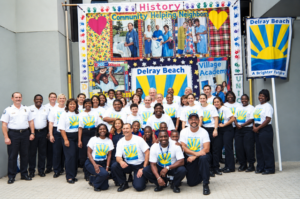
Delray Beach had just won the All-America City Award in Atlanta — our second — and I left  Georgia and took my family somewhere to get lost for a few days.

But we learned that there was going to be a celebration on the grounds of an old house on Swinton Avenue that had a big lawn.

We looked at each other and started packing.

That’s the part I keep coming back to; not the award. The packing. Nobody had to convince anybody. My family cut a vacation short because we didn’t want to read about the celebration in the paper or hear about it later. We wanted to be there. With our neighbors. We couldn’t imagine being anywhere other than home with our friends.

I’ve been thinking about why we felt that way.

The lawn that night was full. People who had made the trip to Atlanta and people who hadn’t. People who had worked on the application for months and people who couldn’t have told you what an All-America City was the week before. Kids everywhere. Nobody checking a program because there wasn’t one.

What I remember most is how long people stayed. They stood on the grass in the warm evening air and talked, and the talking was the thing. We had gone to Atlanta to tell a panel of judges what kind of city we were. But standing on that lawn, we weren’t telling anyone anything. We were just…being it.

Around that same time, in the early 2000s, the city commission started hosting community dinners at the Old School Square fieldhouse.

The formula was almost embarrassingly simple. Pick two neighborhoods — different parts of town, different histories, people who would likely never otherwise sit at the same table. Invite them to dinner. Potluck. No agenda.

That last part mattered more than anything else.

No agenda.

Not a listening session, not a charrette, not a strategic planning exercise dressed up with casseroles. Just dinner and fellowship, which is an old-fashioned word I’ve never found a replacement for.

I was in government then, and government is agenda. Government is action items and public comment and three-minute limits at the podium. I believed in all of it — still do, I think, who knows. It no longer matters as much to me. Other things have come to fill my life.

But I watched something happen at those dinners that never happened in a commission chamber.

People from neighborhoods that had every reason to see each other as strangers — or worse, as competitors for the same scarce attention — passed dishes down long tables and discovered they wanted the same things. Safe streets. Good schools. Somewhere for their kids to be kids. A place where someone would notice if they went missing from their routines.

Safe places for our families. A community where everyone has a chance to thrive. That’s it. That’s the whole list.

Nobody announced this discovery. There was no facilitator with a marker asking us to identify shared values. It just surfaced, the way it does when people eat together, in the small talk that turns out not to be small at all.

I read a piece recently about a backyard concert in another town — three hundred neighbors, folding chairs across three yards, a host whose roots ran generations deep. The writer marveled at how easy it was. Nobody had to sign up or agree on anything. There was simply a reason to gather, and a place to do it.

I felt every word of that story. And it sent me back to that lawn, and that fieldhouse.

Here’s what I can’t stop thinking about. In my years in public life, we spent real money and real effort trying to build community — programs, initiatives, plans with tabs and appendices. Some of it worked. But the moments I’d point to now, the ones that changed how this city felt about itself, cost almost nothing. A lawn. A fieldhouse. Covered dishes. A reason to gather and a place to do it.

Did we build those moments, or did we just get out of their way?

I honestly don’t know. Maybe the best thing an institution can do is set the table — literally set the table — and then stop talking. Maybe trust isn’t something you can program. Maybe it’s something that happens to people while they’re passing the green beans.

What I know is this: at the end of those dinners, the fieldhouse emptied slowly. People lingered by the door the way they’d lingered on the lawn on Swinton, finishing conversations that didn’t want to end. Somebody’s dish went home lighter than it came. Somebody who arrived a stranger left with a phone number on a napkin.

Twenty-some years later, I couldn’t tell you a single agenda item from that era.

But I can still see the lawn. And I miss it.

Note:

I find I’ve been thinking a lot about Dolly Parton since she passed. We lost a true legend August 25. Dolly Parton was 80 and she packed a lot into those years.

 By the time Dolly Parton died on Tuesday, August 25, at the age of 80, her Imagination Library had delivered more than 332 million books to more than 3 million children.

“When I was growing up in the hills of East Tennessee, I knew my dreams would come true,” the Imagination Library website reads. “I know there are children in your community with their own dreams. They dream of becoming a doctor or an inventor or a minister. Who knows, maybe there is a little girl whose dream is to be a writer and singer. The seeds of these dreams are often found in books and the seeds you help plant in your community can grow across the world.”

When children age out of Dolly’s Imagination Library, they receive a final letter from her hoping they would “have a great time” in school and urging them to keep reading.

The letter ends: “You and all of your friends are very special. There is no limit to what you can do or how far you can go. Just remember the lessons my family taught me—dream big dreams; learn everything you can learn; and care for all those who care for you. You do all of these things and you can be anyone you want to be.

“You are terrific, and remember…

“I Will Always Love You.”

We need more Dolly Parton’s in our world.
A Look Back Could Be A Map Forward

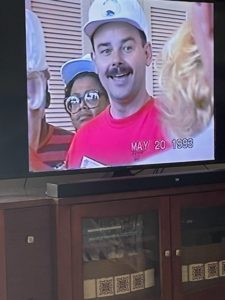
Joe Gillie leading the All America City effort in 1993.

Over the holidays, we spent some time in the 1990s.

We took the trip back through home movies. It was quite an experience.

This is not a usual “thing” for us, but my ex-wife was in town for Christmas, and she gave us all flash drives filled with memories. It was a wonderful gift and deeply appreciated.

We got to “visit” with relatives since departed and hear voices that we miss so much that our hearts literally ache.

We got to see our children when they were little. It was great.

We were reminded once again of how fast life flies by. The home movie experience makes you nostalgic for what seemed like a simpler time.

It’s the everyday stuff that tugs on your heart; seeing your son dig into his first birthday cake (with his hands). Seeing your now grown daughter hugging a long departed beloved pet. Savor these fleeting scenes….they drift into the mist as the days pass by.

As a new year begins, I think that’s a good message to hold onto. Cherish the good stuff. Hold onto hope in this crazy world.

The home movie binge led us an old video of Delray’s 1993 All America City Award win in Tampa.

It was the city’s first win and the victory put Delray on the map nationally. But more importantly, the All America City designation gave the many citizens who were working to build this community the validation that they were on the right track.

A distinguished group of judges—people who knew cities and asked tough questions—took a look at what Delray was doing and gave the city an enthusiastic thumbs up.

My wife, Diane, then the city’s assistant planning director, filmed the event and we think it may be the only video that exists. We’re not sure why, but I guess nobody thought of filming the event.

Viewed today, almost 30 years later, it’s clear that what happened in Tampa was important local history and I think it ought to be required viewing for anyone interested in what it takes to build community and instill civic pride.

Now as good an urban planner as my wife was, she was not exactly an auteur behind the lens. Scorcese she is not. (Sorry, Diane).

Still, she managed to capture the spirit of this community circa 1993 and that spirit was awe-inspiring.

A few things jump out.

—City government was close to its residents.

Neighborhood leaders and the city partnered on a wide range of projects. The Police Department, under the leadership of Chief Rick Overman, was taking community policing to new heights working closely with the grass roots group MAD DADS to take back entire neighborhoods from drug dealers. That effort became legendary, but the video also reveals how integrated the efforts were with the rest of city government. The Community Improvement Department, led by Lula Butler, worked hand in hand with the Planning Department and other city departments to move the needle on blight, crime, and quality of life issues. In those days, everything seemed to be interlocked and when people, systems and organizations are rowing in the same direction you can move mountains. And Delray did.

–There was a laser focus on schools.

When one of the All America City judges asked a tough question about local schools, up came School Board member Bill Graham to testify to the city’s close partnership with the School District. Pretty cool. Delray was a model for other cities on how to partner with the School Board to make meaningful change and they did with new schools (Village Academy), award winning programs (S.D. Spady’s Montessori magnet) and improved facilities (a new Atlantic High School which was built about a decade after the ‘93 All America City Award).

—There was extraordinary camaraderie among citizens.

My favorite parts of the video footage is to see Delray’s diverse community interacting in candid moments. Old and young, Black and white, east and west—there was a real closeness and ease that was evident in those days. Everyone was on board with a common vision. They all shared the same North Star and that’s magical to witness.

I, for one, took that part for granted. Delray was built on vision. Public engagement and involvement was what crafted that vision.

We have gotten away from that and it has caused all sorts of problems.

But in 1993, the community was unified behind Visions 2000 and the Decade of Excellence bond which provided the financing for all sorts of public investments. The citizens backed those efforts because they created the vision and then voted overwhelmingly to fund it.

Those investments yielded an immense return. For the life of me, I will never understand why recent commissions haven’t taken advantage of historically low interest rates (and record tax revenues to satisfy debt) to invest in our infrastructure which is aging and in need of repair.

There’s one more factor that hit me as the camera scanned the crowd and I saw the likes of Frances Bourque, Ken Ellingsworth, Dave Harden, Chris Brown, Tom Fleming, David Kovacs, Robin Smith, Deborah Dowd, Chuck Ridley, Spencer Pompey, Ruth Pompey, Tom Lynch, Jay Alperin, David Kovacs, Helen Coopersmith, Sandra Almy, Ben Bryant, Bob Currie, Dorothy Ellington, Leo Erbstein, Dave Henninger, Mike Weiner, Frank McKinney, Sandy Simon, John Tallentire, Bill Wood and so many others.

These were some really, really special people. The kind of people who move mountains.

All these folks were very different, but they were united in their love for this city, and they gave  their time, talents and treasure to Delray Beach.

I have no doubt that we still have some amazing talent and passion in our city. I see it every day.

But in my opinion our city government is no longer doing the outreach to get people involved. So many people feel adrift as a result.

And it can’t all be blamed on Covid. This drift has been going on long before we heard the word.

We are suffering from a lack of leadership and vision—that’s fatal my friends. Fatal, with a capital F. And if it doesn’t change, you can use that letter to describe what we will be.

We long ago ditched the Town Hall meeting, charrettes and visioning sessions. Now our chances to engage with the city are few and far between and some people have been cancelled because they don’t support the current regime. (see Square, Old School for a prime example).

This isn’t a healthy or productive way to run a city. And the evidence is everywhere (See, turnover and lawsuits for example).

There is a better way.

Sometimes you should look to the past for clues. It is no longer than the 90s. That’s clear. The world has changed.

But some basics never grow old. Kindness, friendship, outreach, engagement and a sincere desire to enlist the community to tackle its challenges will never go out of style. That’s what made us an All America City when that really meant something.

I’ve long ago given up on a few elected officials. Thanks to term limits they will all go some day. But we have a new City Manager. I think he’s the ninth or 50th since Dave Harden retired, I forget which because it has been dizzying to watch. But maybe this one will stick around.

If he’s willing, he ought to spend 20 minutes or so watching the video from 1993. He might get a glimpse of a town that was really working back in those days. He might just learn something.

Email me Mr. Moore. I will make sure you get a copy. I will even find someone who understands what it takes to build community to sit with you (at a respectful social distance of course) and narrate.  I suspect  you are getting a very one-sided view of what Delray is like.  Perhaps you should balance that out.

There are still a few icons from that era who I’m sure would be happy to help you.


Unity in the Community

alone-we-can-do-so-little

Spirit and connectedness.

I’ve been thinking about those two words lately.

What binds us together as a community, as a state, as a nation?

The word united comes first in our national identity: United States.

We are Americans first and foremost, country before party right?

Right?

Yet, we seem to be living in an age of hyper-partisanship. Red States and Blue States. Liberals and Conservatives. Republicans and Democrats.

The divisions are large and seem to be getting larger. And interestingly enough, the divisions are now extremely pronounced even among members of the same political parties. Establishment versus tea party. Establishment versus the Bernie Sanders wing of the Democratic Party.

Any student of American history understands that politics has never been a gentle affair–dating back to the days of Jefferson, Adams and Hamilton our nation’s discourse has always been spirited and at times vitriolic and even violent.

But doesn’t this feel a tad different? Isn’t this year perhaps a few degrees beyond the typical?

Is it possible to unite anymore? Are we beyond sharing a common national spirit? Can we connect?

I’ve always been oriented to the local. So that’s the prism in which I view things.

When I began my career in journalism, I aspired to practice community journalism. I had no desire to cover Washington or the world even though I was interested in both.

When I tried politics it was with the goal of serving in local government. I never aspired to work in state or federal government.

I sensed it was easier to find spirit and connectedness in a small city than on a bigger canvas. And that was important to me. If you can find a tribe that’s committed to building community you can experience real progress. I always felt Delray was large enough and diverse enough to be interesting and small enough to get your arms around and make things happen.

And so it has been.

Boca too…although it’s a vastly different place.

For a long period every initiative, every project, every amenity was viewed through a wide lens not a narrow self interest. Did it build community? Did it serve the long term vision of citizens? Was it a net gain or did it detract from what people were trying to build here?

I think the key to spirit and connection is to have a vision.

The vision must be citizen driven and include a process that is inclusive and invites stakeholders to share.

The process is almost as important as the outcome when it comes to visioning; you want to make sure people are invited to share their thoughts and aspirations in a safe environment that encourages intelligent discussion and deep conversations. People should be encouraged to think big but it’s also important to inject facts and best practices into the conversation to drive the process.

The best visioning exercises are community builders; civic projects that bring people together.

In my mind, that was the real value of the All America City Award which required people to work together in an effort that inevitably tore down barriers and built civic pride.

It’s hard to do this on a national level, but possible. It seems nationally, we rally when threatened; in times of war or terrorism.

On a city level it’s not easy but it’s essential and very doable.

That was Delray’s secret sauce.

And it worked.

When visions are accomplished or grow old and need refreshing and leadership fails to take the time to do bottom up planning you inevitably end up with drift, division and an erosion of civic bonds.

After several successful visioning processes, Delray rushed a visioning process ahead of a mayoral election and major staff upheaval a few years back.

The timing was horrible and the process and its aftermath felt different–somewhat empty not energizing as previous efforts had been.

As a result, Visions 2020 has been mothballed.  It doesn’t drive conversations or inform decision making and even connected citizens can’t remember what it said.

But that doesn’t mean that you can’t try again or that visioning is flawed.

Smart elected officials welcome exercises that build community and forge visions. It helps them make decisions: if something fits the vision you support it. If something is contrary you vote no.

But without a vision there is no real direction– just ad hoc decision making, personal preferences, a whole lot of politics and people feeling disconnected.

Small cities have an option to bring people together. Only the small minded, egotistical and optically driven elected official can’t see that logic. A word to the wise: nobody cares what individual elected officials think. Your job is to forge a vision by bringing as many smart, caring and committed people to the table as you can. That’s leadership because nobody cares if you don’t like the color of a snow fence or the taste of garlic.

It’s not your town or your staff, it all belongs to the stakeholders–those that hold  a stake. Elected officials are stewards and ultimately they work for us; or at least they should.

Congress lost that truism a long time ago. There’s no excuse for local government to follow suit.